Back
Back
Problem 3.5.35
Tangent Lines
In Exercises 35–38, graph the curves over the given intervals, together with their tangent lines at the given values of x. Label each curve and tangent line with its equation.
y = sin x, −3π/2 ≤ x ≤ 2π
x = −π, 0, 3π/2
Problem 3.3.59
The general polynomial of degree n has the form
P(x) = aₙxⁿ + aₙ₋₁xⁿ⁻¹ + ... + a₂x² + a₁x + a₀,
where aₙ ≠ 0. Find P'(x).
Problem 3.6.9
In Exercises 9–18, write the function in the form y = f(u) and u = g(x). Then find dy/dx as a function of x.
y = (2x + 1)⁵
Problem 3.6.69
Finding Derivative Values
In Exercises 67–72, find the value of (f ∘ g)' at the given value of x.
f(u) = cot(πu/10), u = g(x) = 5√x, x = 1
Problem 3.7.39
Slopes, Tangent Lines, and Normal Lines
In Exercises 31–40, verify that the given point is on the curve and find the lines that are (a) tangent and (b) normal to the curve at the given point.
y = 2 sin(πx – y), (1,0)
Problem 3.1.14
In Exercises 11–18, find the slope of the function’s graph at the given point. Then find an equation for the line tangent to the graph there.
g(x) = 8 / x², (2, 2)
Problem 3.8.6
If x = y³ – y and dy/dt = 5, then what is dx/dt when y = 2?
Problem 3.5.29
Derivatives
In Exercises 27–32, find dp/dq.
p = (sin q + cos q) / cos q
Problem 3.6.29
Find the derivatives of the functions in Exercises 19–40.
y = (4x + 3)⁴(x + 1)⁻³
Problem 3.7.16
Find dr/dθ in Exercises 15–18.
r – 2√θ = (3/2)θ²/³ + (4/3)θ³/⁴
Problem 3.81
For what value of c is the curve y = c/ (x + 1) tangent to the line through the points (0, 3) and (5, -2)?
Problem 3.7.5
Differentiating Implicitly
Use implicit differentiation to find dy/dx in Exercises 1–14.
x²(x – y)² = x² – y²
Problem 3.8.9
If L = √(x² + y²), dx/dt = –1, and dy/dt = 3, find dL/dt when x = 5 and y = 12.
Problem 3.5.61
Slopes on the graph of the tangent function Graph y = tan x and its derivative together on (−π/2, π/2). Does the graph of the tangent function appear to have a smallest slope? A largest slope? Is the slope ever negative? Give reasons for your answers.
Problem 3.8.8
If x²y³ = 4/27 and dy/dt = ¹/₂, then what is dx/dt when x = 2?
Problem 3.2.41
In Exercises 41–44, determine whether the piecewise-defined function is differentiable at x = 0.
f(x) = { 2x − 1, x ≥ 0
x² + 2x + 7, x < 0
Problem 3.1.43
[Technology Exercise]
Graph the curves in Exercises 39–48.
a. Where do the graphs appear to have vertical tangent lines?
b. Confirm your findings in part (a) with limit calculations. But before you do, read the introduction to Exercises 37 and 38.
y = 4x²/⁵ − 2x
Problem 3.3.55
For Exercises 55 and 56, evaluate each limit by first converting each to a derivative at a particular x-value.
lim (x → 1) (x⁵⁰ − 1) / (x − 1)
Problem 3.1.18
In Exercises 11–18, find the slope of the function’s graph at the given point. Then find an equation for the line tangent to the graph there.
f(x) = √(x + 1), (8, 3)
Problem 3.3.44
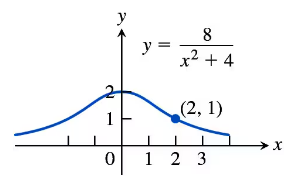
Find the tangent line to the Witch of Agnesi (graphed here) at the point (2,1).
Problem 3.3.2
Derivative Calculations
In Exercises 1–12, find the first and second derivatives.
y = x² + x + 8
Problem 3.7.45
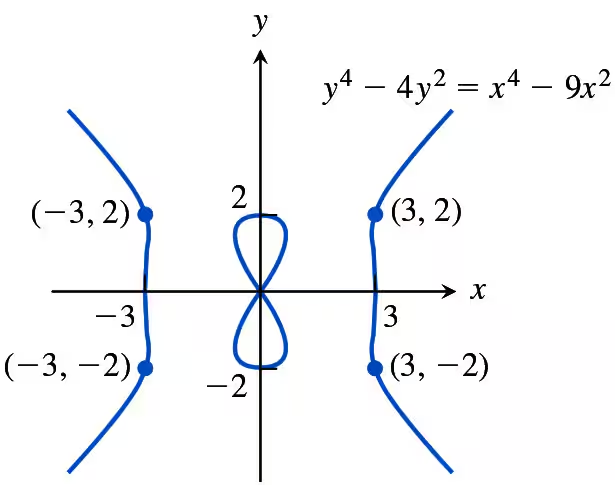
The devil’s curve (Gabriel Cramer, 1750) Find the slopes of the devil’s curve y⁴ – 4y² = x⁴ – 9x² at the four indicated points.
Problem 3.9.23
Derivatives in Differential Form
In Exercises 17–28, find dy.
y = sin(5√x)
Problem 3.7.1
Differentiating Implicitly
Use implicit differentiation to find dy/dx in Exercises 1–14.
x²y + xy² = 6
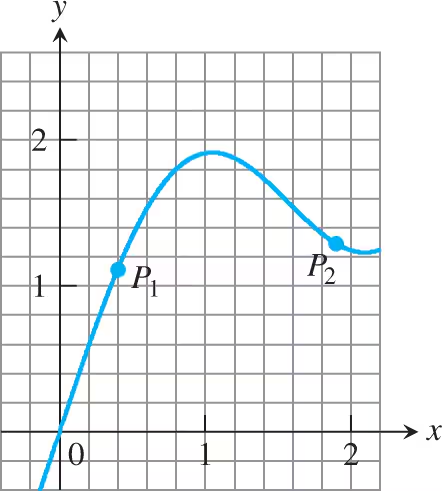
Problem 3.1.3
Slopes and Tangent Lines
In Exercises 1–4, use the grid and a straight edge to make a rough estimate of the slope of the curve (in y-units per x-unit) at the points P₁ and P₂.
Problem 3.87
In Exercises 83–88, find equations for the lines that are tangent, and the lines that are normal, to the curve at the given point.
__
x + √xy = 6, (4, 1)
Problem 3.1.20
In Exercises 19–22, find the slope of the curve at the point indicated.
y = x³ − 2x + 7, x = −2
Problem 3.86
In Exercises 83–88, find equations for the lines that are tangent, and the lines that are normal, to the curve at the given point.
(y - x)² = 2x + 4, (6, 2)
Problem 3.2.56
Tangent line to y = √x Does any tangent line to the curve y = √x cross the x-axis at x = −1? If so, find an equation for the line and the point of tangency. If not, why not?
Problem 3.6.77
Find ds/dt when θ = 3π/2 if s = cosθ and dθ/dt = 5.