Back
Back
Problem 3.89
Find the slope of the curve x³y³ + y² = x + y at the points (1, 1) and (1, -1).
Problem 3.3.2
Derivative Calculations
In Exercises 1–12, find the first and second derivatives.
y = x² + x + 8
Problem 3.2.43
In Exercises 41–44, determine whether the piecewise-defined function is differentiable at x = 0.
f(x) = { 2x + tan x, x ≥ 0
x², x < 0
Problem 3.5.35
Tangent Lines
In Exercises 35–38, graph the curves over the given intervals, together with their tangent lines at the given values of x. Label each curve and tangent line with its equation.
y = sin x, −3π/2 ≤ x ≤ 2π
x = −π, 0, 3π/2
Problem 3.6.54
In Exercises 41–58, find dy/dt.
y = 4 sin(√(1 + √t))
Problem 3.6.6
Derivative Calculations
In Exercises 1–8, given y = f(u) and u = g(x), find dy/dx = f'(g(x)) g'(x).
y = sin u, u = x − cos x
Problem 3.6.58
In Exercises 41–58, find dy/dt.
y = √(3t + (√2 + √(1 − t)))
Problem 3.5.31
Derivatives
In Exercises 27–32, find dp/dq.
p = (q sin q) / (q² − 1)
Problem 3.5.17
Derivatives
In Exercises 1–18, find dy/dx.
f(x) = x³ sin x cos x
Problem 3.6.68
Finding Derivative Values
In Exercises 67–72, find the value of (f ∘ g)' at the given value of x.
f(u) = 1 − (1/u), u = g(x) = (1 / (1 − x)), x = −1
Problem 3.1.43
[Technology Exercise]
Graph the curves in Exercises 39–48.
a. Where do the graphs appear to have vertical tangent lines?
b. Confirm your findings in part (a) with limit calculations. But before you do, read the introduction to Exercises 37 and 38.
y = 4x²/⁵ − 2x
Problem 3.8.8
If x²y³ = 4/27 and dy/dt = ¹/₂, then what is dx/dt when x = 2?
Problem 3.7.1
Differentiating Implicitly
Use implicit differentiation to find dy/dx in Exercises 1–14.
x²y + xy² = 6
Problem 3.4.11
Finding g on a small airless planet Explorers on a small airless planet used a spring gun to launch a ball bearing vertically upward from the surface at a launch velocity of 15 m/sec. Because the acceleration of gravity at the planet’s surface was gₛ m/sec², the explorers expected the ball bearing to reach a height of s = 15t − (1/2)gₛt² m t sec later. The ball bearing reached its maximum height 20 sec after being launched. What was the value of gₛ?
Problem 3
Finding Derivative Functions and Values
Using the definition, calculate the derivatives of the functions in Exercises 1–6. Then find the values of the derivatives as specified.
g(t) = 1/t²; g′(−1), g′(2), g′(√3)
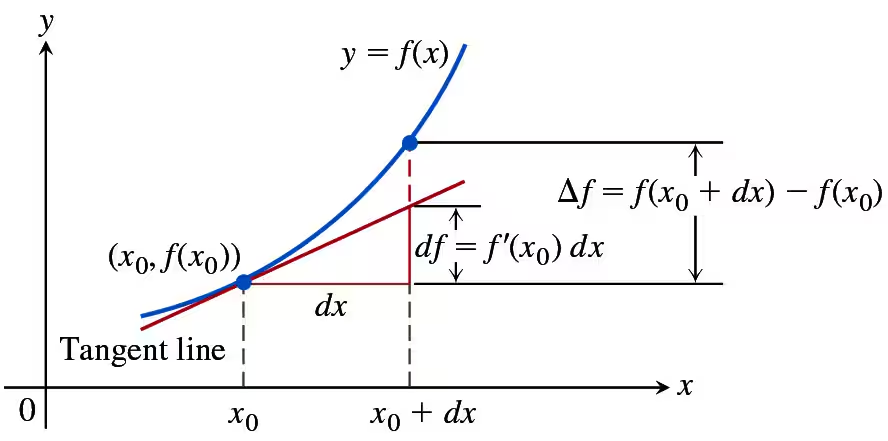
Problem 3.9.32
Approximation Error
In Exercises 29–34, each function f(x) changes value when x changes from x₀ to x₀ + dx. Find
a. the change Δf = f(x₀ + dx) − f(x₀);
b. the value of the estimate df = fʹ(x₀) dx; and
c. the approximation error |Δf − df|.
f(x) = x⁴, x₀ = 1, dx = 0.1
Problem 3.3
Find the derivatives of the functions in Exercises 1–42.
𝔂 = x³ - 3 (x² + π²)
Problem 3.2.58
Derivative of multiples Does knowing that a function g(t) is differentiable at t = 7 tell you anything about the differentiability of the function 3g at t = 7? Give reasons for your answer.
Problem 3.1.28
Find an equation of the straight line having slope 1/4 that is tangent to the curve y = √x.
Problem 3.2.44
In Exercises 41–44, determine whether the piecewise-defined function is differentiable at x = 0.
g(x) = { 2x − x³ − 1, x ≥ 0
x − (1 / (x + 1)), x < 0
Problem 3.6.60
Second Derivatives
Find y'' in Exercises 59–64.
y = (1 − √x)⁻¹
Problem 3.1.8
In Exercises 5–10, find an equation for the tangent line to the curve at the given point. Then sketch the curve and tangent line together.
y = (1 / x²), (−1, 1)
Problem 3.6.78
Find dy/dt when x = 1 if y = x² + 7x − 5 and dx/dt = ¹/₃.
Problem 3.2.25
Using the Alternative Formula for Derivatives
Use the formula
f'(x) = lim (z → x) (f(z) − f(x)) / (z − x)
to find the derivative of the functions in Exercises 23–26.
g(x) = x / (x − 1)
Problem 3.6.41
In Exercises 41–58, find dy/dt.
y = sin²(πt − 2)
Problem 3.7.12
Differentiating Implicitly
Use implicit differentiation to find dy/dx in Exercises 1–14.
x⁴ + sin y = x³y²
Problem 3.7.47
Theory and Examples
Intersecting normal line The line that is normal to the curve x² + 2xy – 3y² = 0 at (1,1) intersects the curve at what other point?
Problem 3.6.45
In Exercises 41–58, find dy/dt.
y = (t tan(t))¹⁰
Problem 3.1.20
In Exercises 19–22, find the slope of the curve at the point indicated.
y = x³ − 2x + 7, x = −2
Problem 3.6.77
Find ds/dt when θ = 3π/2 if s = cosθ and dθ/dt = 5.