Back
Back
Problem 3.1.20
In Exercises 19–22, find the slope of the curve at the point indicated.
y = x³ − 2x + 7, x = −2
Problem 3.33
Find the derivatives of the functions in Exercises 1–42.
_____
𝔂 = / x² + x
√ x²
Problem 3.9.38
Differential Estimates of Change
In Exercises 35–40, write a differential formula that estimates the given change in volume or surface area.
The change in the lateral surface area S = πr√(r² + h²) of a right circular cone when the radius changes from r₀ to r₀ + dr and the height does not change
Problem 3.3.9
Derivative Calculations
In Exercises 1–12, find the first and second derivatives.
y = 6x² − 10x − 5x⁻²
Problem 3.87
In Exercises 83–88, find equations for the lines that are tangent, and the lines that are normal, to the curve at the given point.
__
x + √xy = 6, (4, 1)
Problem 3.5.49
Theory and Examples
The equations in Exercises 49 and 50 give the position s = f(t) of a body moving on a coordinate line (s in meters, t in seconds). Find the body’s velocity, speed, acceleration, and jerk at time t = π/4 sec.
s = 2 − 2 sin t
Problem 3.1.43
[Technology Exercise]
Graph the curves in Exercises 39–48.
a. Where do the graphs appear to have vertical tangent lines?
b. Confirm your findings in part (a) with limit calculations. But before you do, read the introduction to Exercises 37 and 38.
y = 4x²/⁵ − 2x
Problem 3.9.29
Approximation Error
In Exercises 29–34, each function f(x) changes value when x changes from x₀ to x₀ + dx. Find
a. the change Δf = f(x₀ + dx) − f(x₀);
b. the value of the estimate df = fʹ(x₀) dx; and
c. the approximation error |Δf − df|.
<IMAGE>
f(x) = x² + 2x, x₀ = 1, dx = 0.1
Problem 3.3.61
Suppose that the function v in the Derivative Product Rule has a constant value c. What does the Derivative Product Rule then say? What does this say about the Derivative Constant Multiple Rule?
Problem 3.3.59
The general polynomial of degree n has the form
P(x) = aₙxⁿ + aₙ₋₁xⁿ⁻¹ + ... + a₂x² + a₁x + a₀,
where aₙ ≠ 0. Find P'(x).
Problem 3.6.9
In Exercises 9–18, write the function in the form y = f(u) and u = g(x). Then find dy/dx as a function of x.
y = (2x + 1)⁵
Problem 3.51
In Exercises 51 and 52, find dp/dq.
p³ + 4pq - 3q² = 2
Problem 3.7.39
Slopes, Tangent Lines, and Normal Lines
In Exercises 31–40, verify that the given point is on the curve and find the lines that are (a) tangent and (b) normal to the curve at the given point.
y = 2 sin(πx – y), (1,0)
Problem 3.3.4
Derivative Calculations
In Exercises 1–12, find the first and second derivatives.
w = 3z⁷ − 7z³ + 21z²
Problem 3.3.65
Cylinder pressure If gas in a cylinder is maintained at a constant temperature T, the pressure P is related to the volume V by a formula of the form
P = (nRT / (V − nb)) − (an² / V²),
in which a, b, n, and R are constants. Find dP/dV. (See accompanying figure.)
<IMAGE>
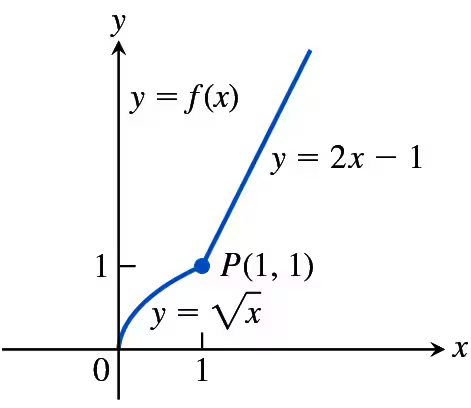
Problem 3.2.39
One-Sided Derivatives
Compute the right-hand and left-hand derivatives as limits to show that the functions in Exercises 37–40 are not differentiable at the point P.
Problem 3.6.29
Find the derivatives of the functions in Exercises 19–40.
y = (4x + 3)⁴(x + 1)⁻³
Problem 3.1.14
In Exercises 11–18, find the slope of the function’s graph at the given point. Then find an equation for the line tangent to the graph there.
g(x) = 8 / x², (2, 2)
Problem 3.6.33
Find the derivatives of the functions in Exercises 19–40.
f(x) = √(7 + x sec x)
Problem 3.3.28
Find the derivatives of the functions in Exercises 17–28.
y = ((x + 1)(x + 2)) / ((x − 1)(x − 2))
Problem 3.8.5
If y = x² and dx/dt = 3, then what is dy/dt when x = –1?
Problem 3.9.47
Tolerance The height and radius of a right circular cylinder are equal, so the cylinder’s volume is V = πh³. The volume is to be calculated with an error of no more than 1% of the true value. Find approximately the greatest error that can be tolerated in the measurement of h, expressed as a percentage of h.
Problem 3.5.15
Derivatives
In Exercises 1–18, find dy/dx.
y = (sec x + tan x)(sec x − tan x)
Problem 3.6.89
Falling meteorite The velocity of a heavy meteorite entering Earth’s atmosphere is inversely proportional to √s when it is s km from Earth’s center. Show that the meteorite’s acceleration is inversely proportional to s².
Problem 3.7.22
Second Derivatives
In Exercises 19–26, use implicit differentiation to find dy/dx and then d²y/dx². Write the solutions in terms of x and y only.
y² – 2x = 1 – 2y
Problem 3.1.22
In Exercises 19–22, find the slope of the curve at the point indicated.
y = (x − 1) / (x + 1), x = 0
Problem 3.70
For what value or values of the constant m, if any, is
ƒ(x) = { sin 2x, x ≤ 0
{ mx, x > 0
a. continuous at x = 0?
b. differentiable at x = 0?
Give reasons for your answers.
Problem 3
Finding Derivative Functions and Values
Using the definition, calculate the derivatives of the functions in Exercises 1–6. Then find the values of the derivatives as specified.
g(t) = 1/t²; g′(−1), g′(2), g′(√3)
Problem 3.6.77
Find ds/dt when θ = 3π/2 if s = cosθ and dθ/dt = 5.
Problem 3.9.20
Derivatives in Differential Form
In Exercises 17–28, find dy.
y = (2√x)/(3(1 + √x))