Find fg and determine the domain for each function. f(x)= = 8x/(x - 2), g(x) = 6/(x+3)
Verified step by step guidance
1
Step 1: Understand the problem. You are tasked with finding the composition of two functions, fg(x), which means f(g(x)). This involves substituting g(x) into f(x). Additionally, you need to determine the domain of the resulting function, which is the set of all x-values for which the function is defined.
Step 3: Simplify the numerator and denominator. The numerator becomes 8 * (6 / (x + 3)) = 48 / (x + 3). The denominator is (6 / (x + 3)) - 2. To simplify the denominator, rewrite 2 as (2(x + 3)) / (x + 3), so the denominator becomes (6 / (x + 3)) - (2(x + 3) / (x + 3)). Combine the terms in the denominator under a common denominator.
Step 4: Combine the terms in the denominator. The denominator becomes (6 - 2(x + 3)) / (x + 3). Simplify the numerator of the denominator: 6 - 2(x + 3) = 6 - 2x - 6 = -2x. So the denominator becomes -2x / (x + 3).
Step 5: Write the final simplified expression for f(g(x)). Substitute the simplified numerator and denominator into the composition: f(g(x)) = (48 / (x + 3)) / (-2x / (x + 3)). Simplify by multiplying by the reciprocal of the denominator: f(g(x)) = (48 / (x + 3)) * ((x + 3) / -2x). Cancel out (x + 3) (as long as x ≠ -3), leaving f(g(x)) = 48 / (-2x). Finally, determine the domain by excluding values that make any denominator zero: x ≠ -3 (from g(x)) and x ≠ 0 (from the final expression).
Verified video answer for a similar problem:
This video solution was recommended by our tutors as helpful for the problem above
Video duration:
5m
Play a video:
0 Comments
Key Concepts
Here are the essential concepts you must grasp in order to answer the question correctly.
Function Composition
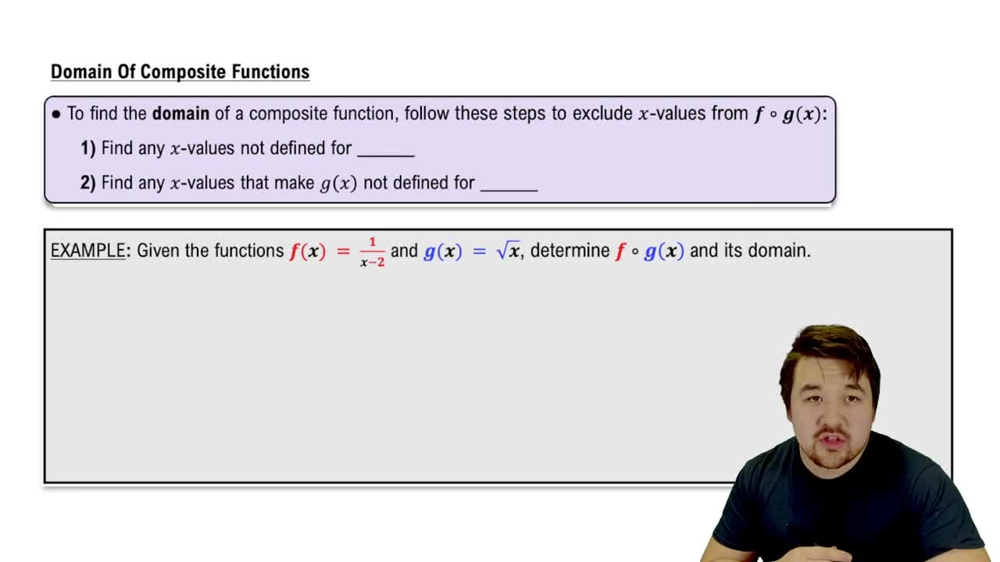
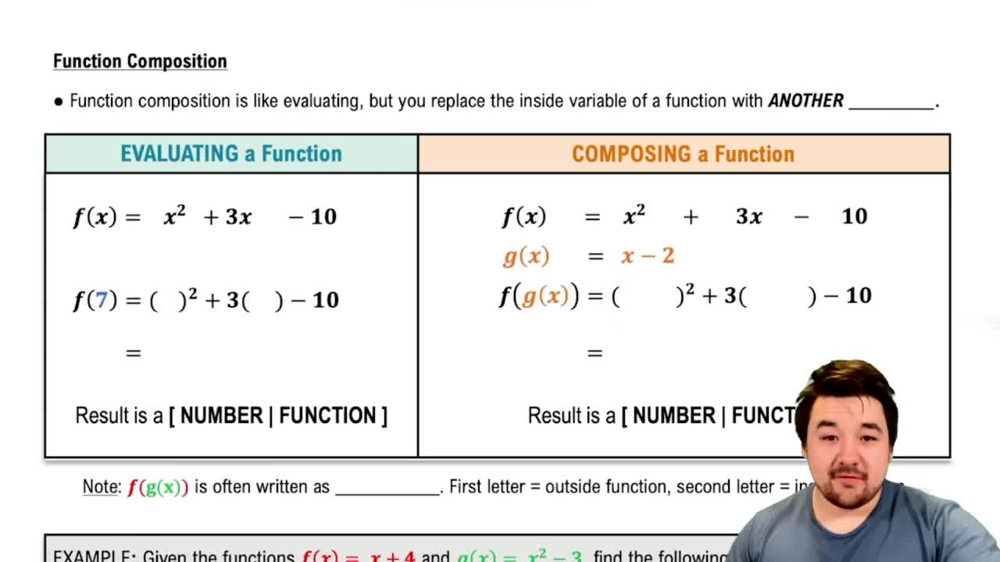
Function composition involves combining two functions, where the output of one function becomes the input of another. In this case, fg means f(g(x)), which requires substituting g(x) into f(x). Understanding how to perform this substitution is crucial for finding the composite function.
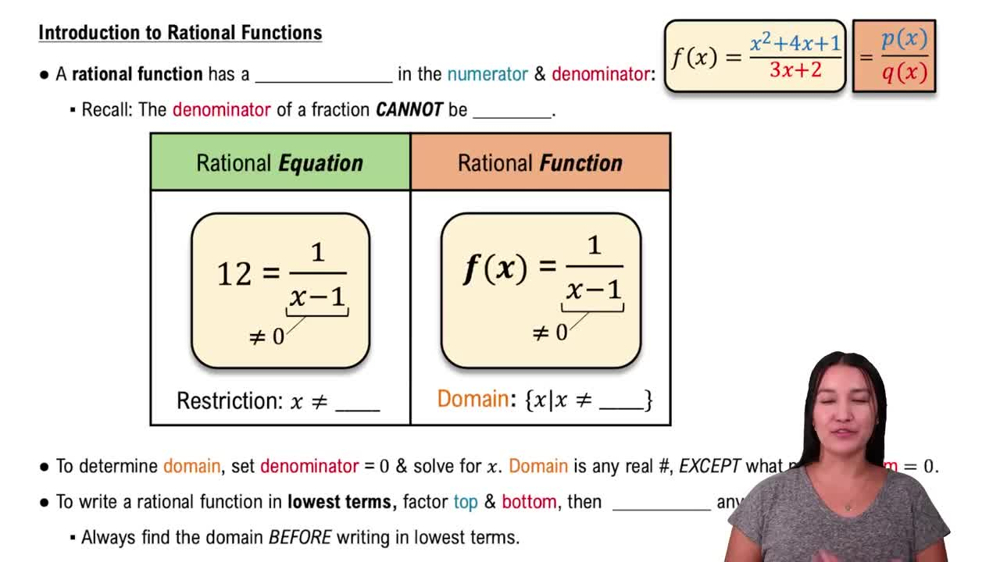
The domain of a function is the set of all possible input values (x-values) for which the function is defined. For rational functions like f(x) and g(x), the domain is restricted by values that make the denominator zero. Identifying these restrictions is essential for determining the overall domain of the composite function.
Rational functions are ratios of polynomials, expressed in the form f(x) = P(x)/Q(x), where P and Q are polynomials. The behavior of these functions, including their asymptotes and discontinuities, is influenced by the zeros of the denominator. Understanding rational functions is key to analyzing their domains and compositions.

 5:33 minutes
 Verified step by step guidance
 4:56
4:56