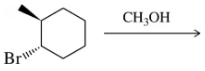
Predict the product of the following substitution reactions, making sure to note whether a rearrangement should occur. (b)
Verified step by step guidance
1
Step 1: Analyze the given reaction. The substrate is a cyclohexyl bromide with a bromine atom attached to the ring in a wedge configuration. The solvent is methanol (CH₃OH), which is a polar protic solvent. This suggests that the reaction may proceed via an SN1 mechanism.
Step 2: Consider the mechanism. In an SN1 reaction, the first step is the formation of a carbocation intermediate. The bromine atom leaves, generating a cyclohexyl carbocation. Since the carbocation is planar, it can undergo rearrangement if a more stable carbocation can form.
Step 3: Check for possible rearrangements. The cyclohexyl carbocation is already relatively stable due to its secondary nature. No rearrangement is likely to occur because there is no adjacent tertiary carbon or other stabilizing group to improve the carbocation's stability.
Step 4: Nucleophilic attack. Methanol (CH₃OH) acts as the nucleophile and attacks the carbocation, forming a new bond. Since the carbocation is planar, the attack can occur from either side, leading to a racemic mixture of products.
Step 5: Proton transfer. After the nucleophilic attack, the oxygen in methanol will have a positive charge. A proton transfer occurs, where a base (possibly another methanol molecule) removes the proton, resulting in the final product: a cyclohexyl methyl ether (CH₃O attached to the cyclohexane ring).
Verified video answer for a similar problem:
This video solution was recommended by our tutors as helpful for the problem above
Play a video:
0 Comments
Key Concepts
Here are the essential concepts you must grasp in order to answer the question correctly.
Nucleophilic Substitution Reactions
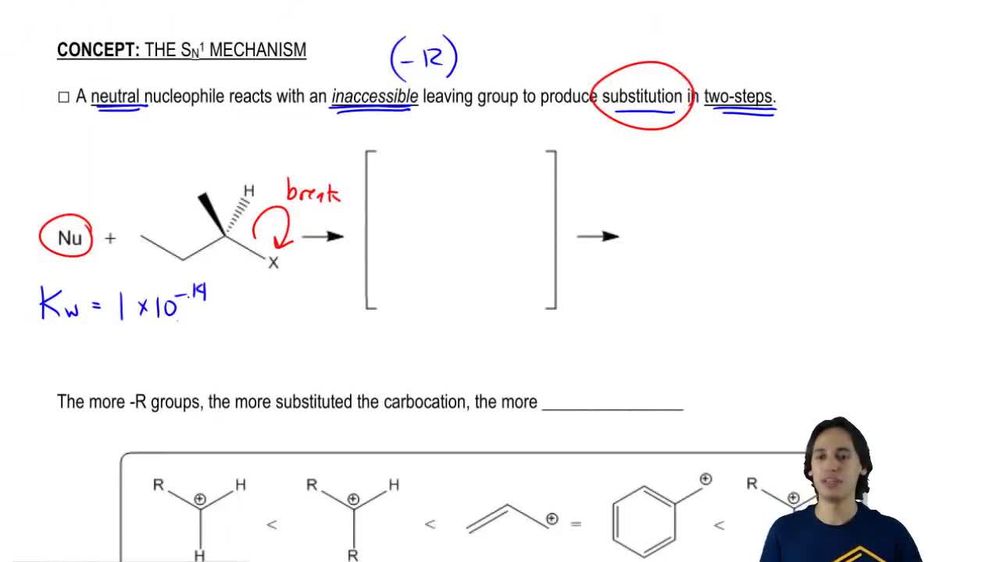
Nucleophilic substitution reactions involve the replacement of a leaving group (like Br) by a nucleophile (like CH3OH). The nucleophile donates a pair of electrons to form a new bond, while the leaving group departs with its electrons. Understanding the mechanism, whether it follows an SN1 or SN2 pathway, is crucial for predicting the product.
Nucleophiles and Electrophiles can react in Substitution Reactions.
Mechanism of SN1 and SN2 Reactions
SN1 reactions proceed via a two-step mechanism involving the formation of a carbocation intermediate, while SN2 reactions occur in a single concerted step. The choice between these mechanisms depends on factors like substrate structure and the nature of the nucleophile. Recognizing which mechanism applies helps in predicting rearrangements and the final product.
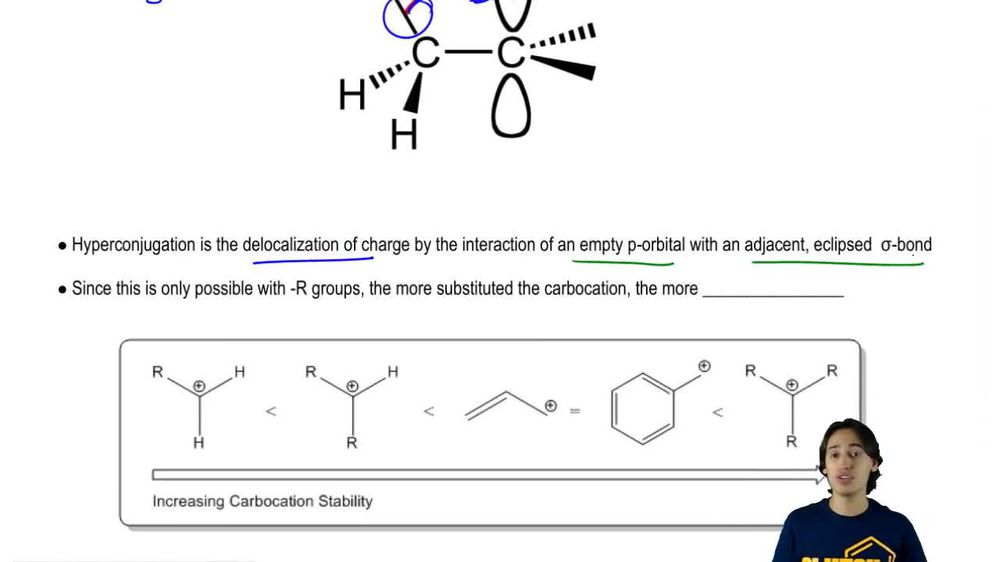
Carbocation stability is a key factor in determining the outcome of nucleophilic substitution reactions. More stable carbocations (tertiary > secondary > primary) are less likely to rearrange. However, if a more stable carbocation can be formed through rearrangement, it will occur, influencing the final product of the reaction.

 Verified step by step guidance
 01:47
01:47