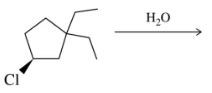
Predict the product of the following substitution reactions, making sure to note whether a rearrangement should occur. (d)
Verified step by step guidance
1
Step 1: Identify the type of substitution reaction. Since the solvent is water (H2O), this reaction is likely to proceed via an SN1 mechanism, as water is a polar protic solvent that stabilizes carbocations.
Step 2: Determine the leaving group. The chlorine atom (Cl) is the leaving group, and it will depart to form a carbocation intermediate.
Step 3: Analyze the carbocation intermediate for stability. The initial carbocation formed is a secondary carbocation. Check for possible rearrangements to form a more stable carbocation, such as a tertiary carbocation via a hydride or alkyl shift.
Step 4: Once the most stable carbocation is formed, water (H2O) will act as a nucleophile and attack the carbocation, forming a bond with the positively charged carbon.
Step 5: Deprotonation occurs. The water molecule that bonded to the carbocation will lose a proton (H+) to form the final alcohol product.
Verified video answer for a similar problem:
This video solution was recommended by our tutors as helpful for the problem above
Play a video:
0 Comments
Key Concepts
Here are the essential concepts you must grasp in order to answer the question correctly.
Nucleophilic Substitution Reactions
Nucleophilic substitution reactions involve the replacement of a leaving group (like Cl) by a nucleophile (such as H2O). In these reactions, the nucleophile attacks the electrophilic carbon atom bonded to the leaving group, leading to the formation of a new bond and the departure of the leaving group. Understanding the mechanism, whether it follows an SN1 or SN2 pathway, is crucial for predicting the product.
Nucleophiles and Electrophiles can react in Substitution Reactions.
Carbocation Stability
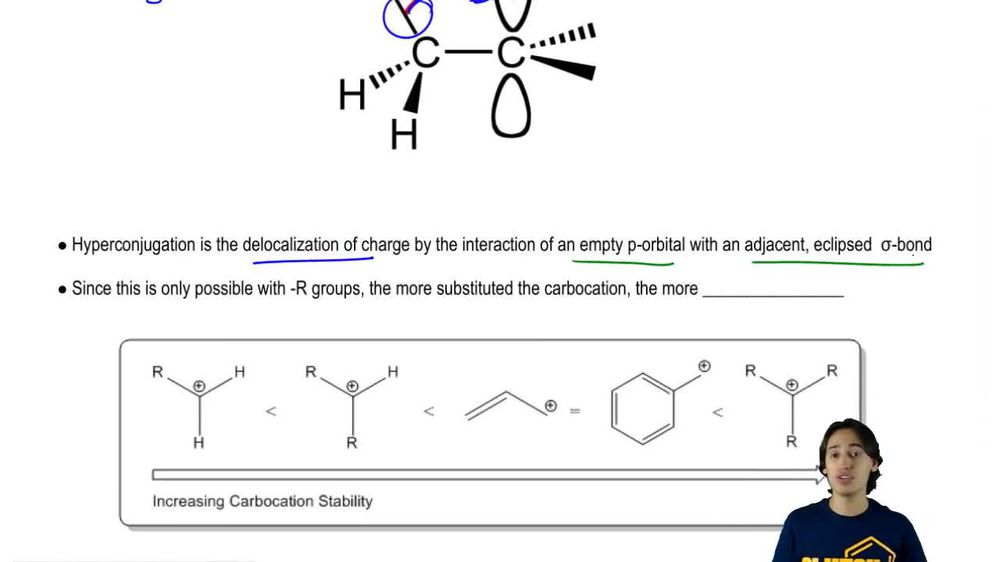
In reactions involving carbocations, the stability of the carbocation intermediate significantly influences the reaction pathway. Tertiary carbocations are more stable than secondary or primary ones due to hyperconjugation and inductive effects. If a carbocation forms during the reaction, it may lead to rearrangements to form a more stable carbocation, which can affect the final product.
Rearrangement in substitution reactions occurs when a carbocation intermediate can shift to a more stable configuration. This can involve hydride or alkyl shifts, allowing the molecule to achieve a lower energy state. Recognizing when and how rearrangements happen is essential for accurately predicting the final product of the reaction, especially in complex cyclic structures.

 Verified step by step guidance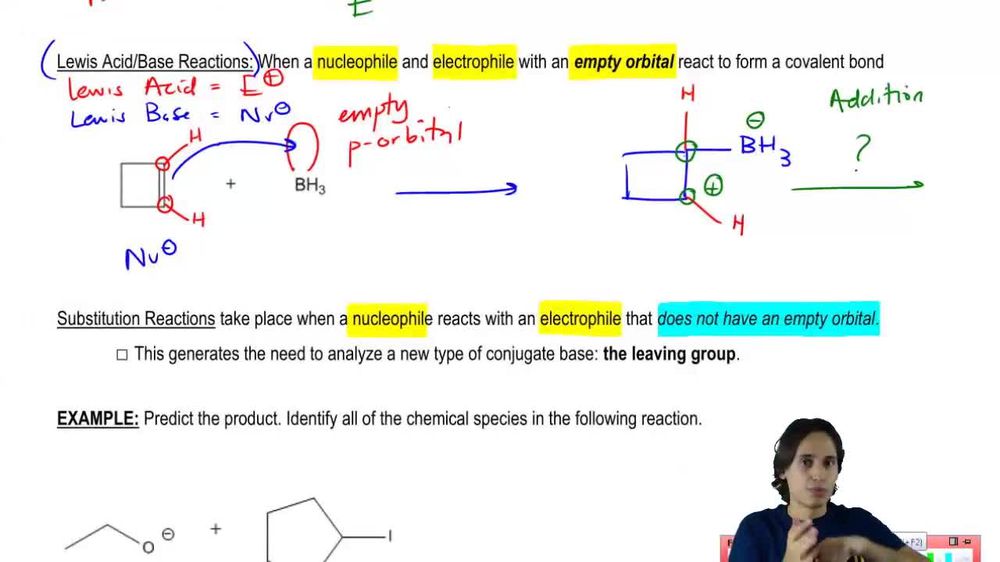
 01:47
01:47