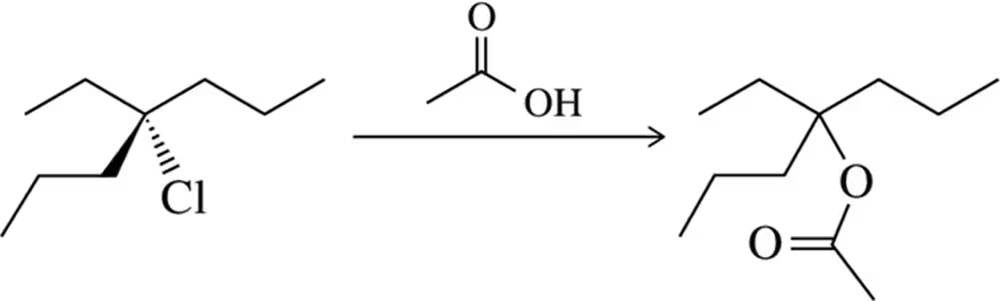
Suggest a mechanism for the following substitution reactions. (d)
Verified step by step guidance
1
Step 1: Analyze the reactants and products. The reactant is a secondary alkyl chloride, and the product is an ester formed by substitution with acetic acid (CH₃COOH). This suggests a nucleophilic substitution reaction mechanism.
Step 2: Identify the nucleophile and leaving group. In this reaction, acetic acid acts as the nucleophile, and the chloride ion (Cl⁻) is the leaving group. The reaction likely proceeds via an SN1 or SN2 mechanism depending on the conditions.
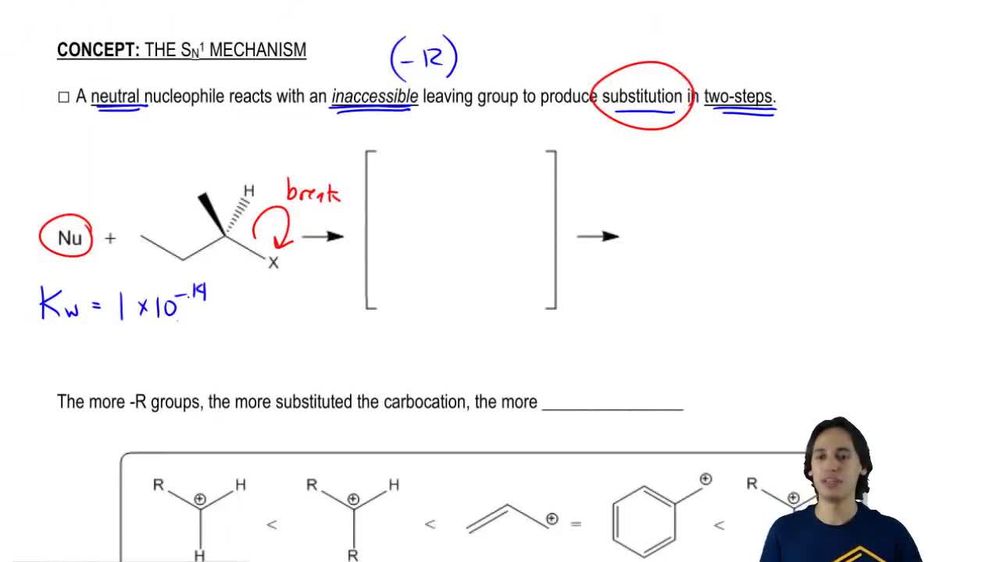
Step 3: Consider the mechanism. Since the carbon attached to the chlorine is secondary, steric hindrance is moderate, and the reaction could proceed via an SN2 mechanism if the conditions favor a strong nucleophile. Alternatively, under acidic conditions, the reaction could proceed via an SN1 mechanism, involving carbocation formation.
Step 4: Describe the SN2 mechanism. In an SN2 mechanism, the nucleophile (acetic acid) attacks the carbon bearing the leaving group (Cl) in a single concerted step, leading to the inversion of stereochemistry at the carbon center. The chloride ion departs simultaneously.
Step 5: Describe the SN1 mechanism. In an SN1 mechanism, the chloride ion first leaves, forming a secondary carbocation intermediate. Acetic acid then attacks the carbocation, forming the ester product. If the reaction proceeds via SN1, stereochemistry at the carbon center may be lost, resulting in a racemic mixture.
Verified video answer for a similar problem:
This video solution was recommended by our tutors as helpful for the problem above
Play a video:
0 Comments
Key Concepts
Here are the essential concepts you must grasp in order to answer the question correctly.
Nucleophilic Substitution Reactions
Nucleophilic substitution reactions involve the replacement of a leaving group (like Cl) by a nucleophile (such as OH-). The nucleophile attacks the electrophilic carbon atom bonded to the leaving group, leading to the formation of a new bond while the leaving group departs. Understanding the nature of the nucleophile and the substrate is crucial for predicting the reaction pathway.
Nucleophiles and Electrophiles can react in Substitution Reactions.
Mechanism Types: SN1 and SN2
Substitution reactions can proceed via two main mechanisms: SN1 and SN2. SN1 is a two-step process where the leaving group departs first, forming a carbocation intermediate, followed by nucleophilic attack. SN2 is a one-step process where the nucleophile attacks the substrate simultaneously as the leaving group departs. The choice between these mechanisms depends on factors like substrate structure and nucleophile strength.
Stereochemistry plays a significant role in substitution reactions, particularly in SN2 mechanisms, which result in inversion of configuration at the chiral center. In contrast, SN1 reactions can lead to racemization due to the formation of a planar carbocation intermediate. Understanding the stereochemical outcomes is essential for predicting the properties of the products formed in these reactions.

 Verified step by step guidance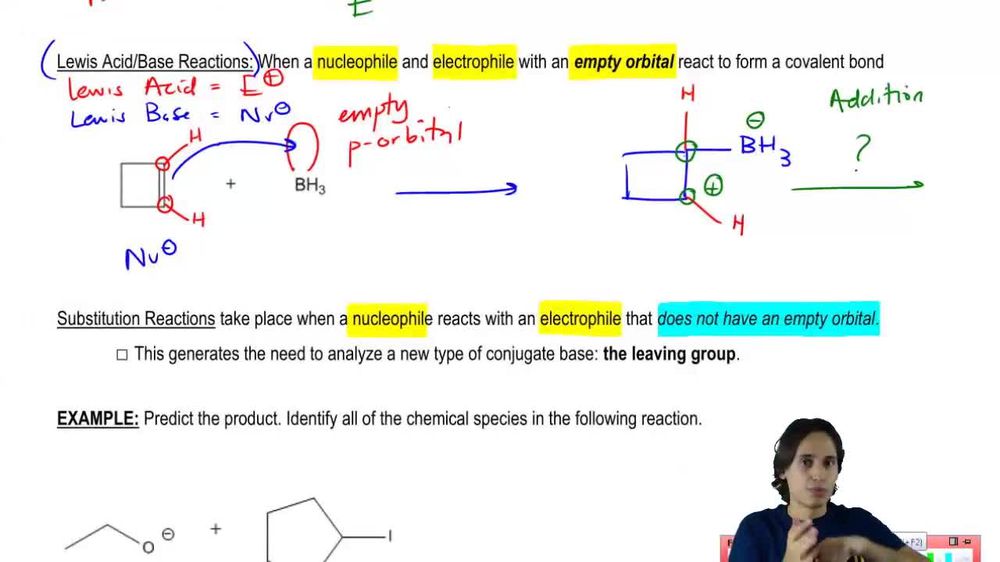
 01:47
01:47