Suggest a mechanism for the following substitution reactions. (c)
Verified step by step guidance
1
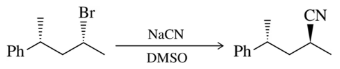
Step 1: Identify the type of substitution reaction. The presence of NaCN (a strong nucleophile) and DMSO (a polar aprotic solvent) suggests that this reaction proceeds via an SN2 mechanism.
Step 2: Recognize the stereochemical implications of an SN2 reaction. In an SN2 mechanism, the nucleophile attacks the electrophilic carbon from the opposite side of the leaving group, resulting in an inversion of configuration at the carbon center.
Step 3: Analyze the structure of the substrate. The substrate is a secondary alkyl bromide with a phenyl group attached. Bromine is the leaving group, and the carbon bonded to bromine is the electrophilic center.
Step 4: Describe the nucleophilic attack. The cyanide ion (CN⁻) attacks the electrophilic carbon from the opposite side of the bromine, displacing the bromine atom as Br⁻. This occurs in a single concerted step, characteristic of the SN2 mechanism.
Step 5: Explain the stereochemical outcome. Due to the backside attack by CN⁻, the configuration at the carbon center is inverted, resulting in the product where the CN group is attached with opposite stereochemistry compared to the original bromine group.
Verified video answer for a similar problem:
This video solution was recommended by our tutors as helpful for the problem above
Play a video:
0 Comments
Key Concepts
Here are the essential concepts you must grasp in order to answer the question correctly.
Nucleophilic Substitution Reactions
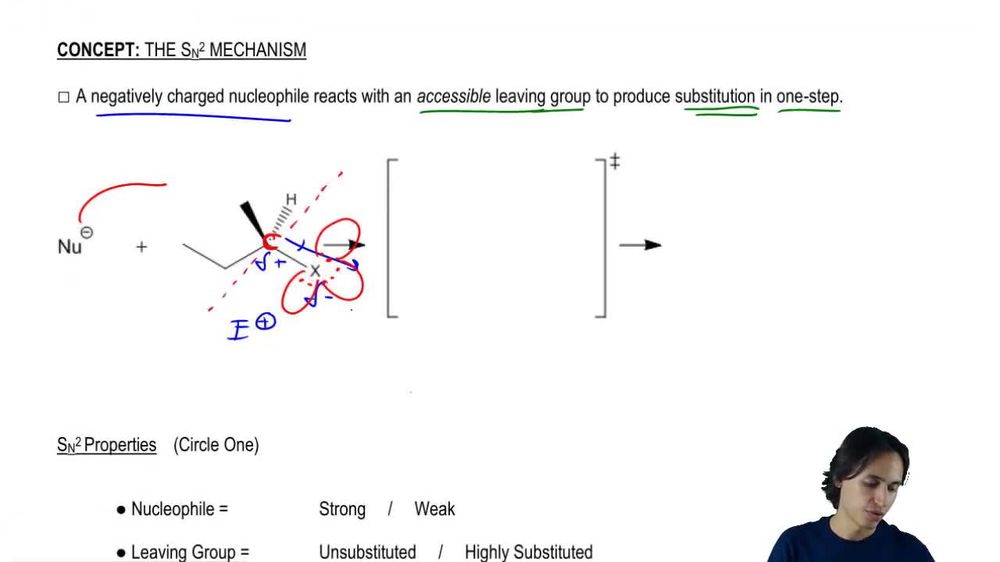
Nucleophilic substitution reactions involve the replacement of a leaving group in a molecule by a nucleophile. In this case, the bromine atom (Br) is the leaving group, and sodium cyanide (NaCN) provides the cyanide ion (CN-) as the nucleophile. Understanding the mechanism of these reactions, such as whether they proceed via an SN1 or SN2 pathway, is crucial for predicting the outcome of the reaction.
Nucleophiles and Electrophiles can react in Substitution Reactions.
SN2 Mechanism
The SN2 mechanism is a type of nucleophilic substitution characterized by a single concerted step where the nucleophile attacks the electrophile from the opposite side of the leaving group. This results in a transition state where both the nucleophile and the leaving group are partially bonded to the carbon atom. The reaction is stereospecific, leading to inversion of configuration at the carbon center, which is relevant in this substitution reaction.
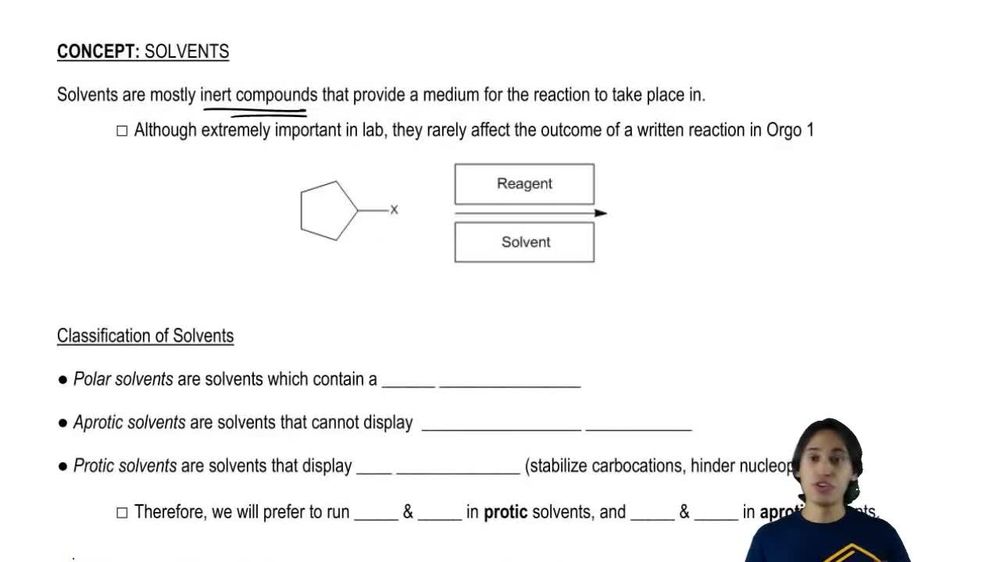
The choice of solvent can significantly influence the rate and outcome of organic reactions. DMSO (dimethyl sulfoxide) is a polar aprotic solvent that stabilizes ions and enhances the nucleophilicity of the cyanide ion in this reaction. Understanding how solvents affect reaction mechanisms is essential for predicting reaction behavior and optimizing conditions for desired products.

 Verified step by step guidance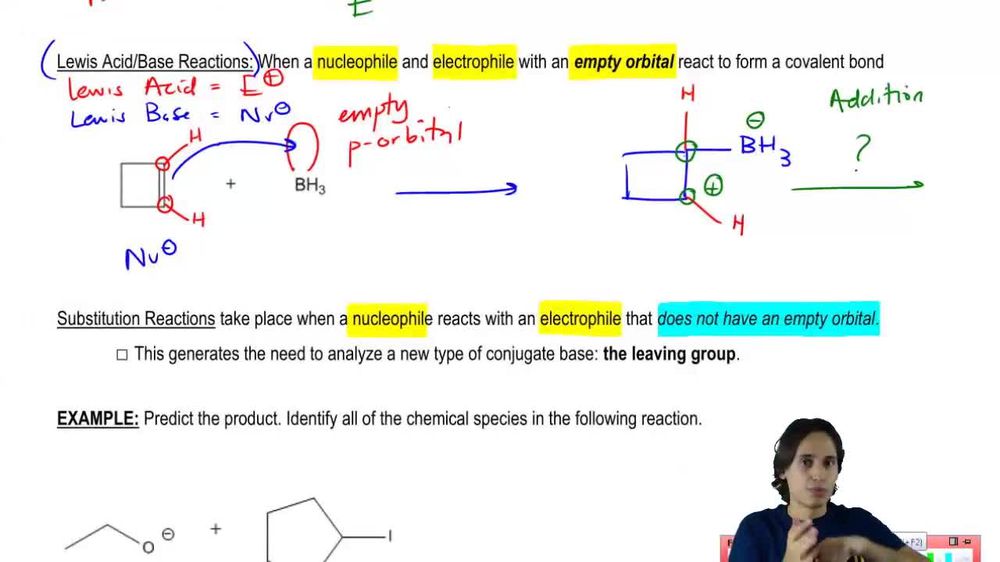
 01:47
01:47