Draw the structures and name the four constitutional isomers with molecular formula C4H9Br.
Verified step by step guidance
1
Understand the problem: Constitutional isomers are compounds with the same molecular formula but different connectivity of atoms. Here, we need to draw and name four isomers of C4H9Br, which means they all have four carbons, nine hydrogens, and one bromine atom, but differ in how the atoms are connected.
Step 1: Start with the straight-chain structure (n-butane) as the parent chain. Replace one hydrogen atom with a bromine atom at different positions to create two isomers: 1-bromobutane and 2-bromobutane. Draw their structures and name them accordingly.
Step 2: Consider branching the carbon chain to form isobutane (2-methylpropane) as the parent chain. Replace one hydrogen atom with a bromine atom at different positions to create two more isomers: 1-bromo-2-methylpropane and 2-bromo-2-methylpropane. Draw their structures and name them accordingly.
Step 3: Verify that all four structures are unique and meet the molecular formula C4H9Br. Ensure that no two structures are identical and that all possible connectivity variations have been considered.
Step 4: Double-check the IUPAC names for each isomer to ensure they are correct and follow the naming conventions. Confirm that the names correspond to the drawn structures.
Verified video answer for a similar problem:
This video solution was recommended by our tutors as helpful for the problem above
Video duration:
5m
Play a video:
0 Comments
Key Concepts
Here are the essential concepts you must grasp in order to answer the question correctly.
Constitutional Isomers
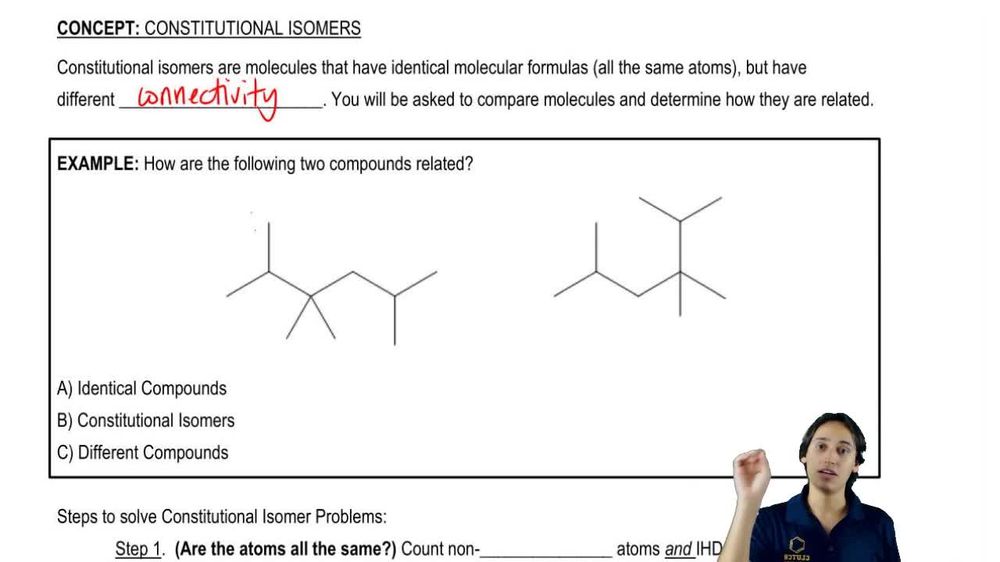
Constitutional isomers are compounds that have the same molecular formula but differ in the connectivity of their atoms. This means that while they share the same number of each type of atom, the arrangement of these atoms leads to different chemical structures and properties. Understanding constitutional isomers is crucial for identifying and naming different compounds that can exist with the same formula.
A molecular formula indicates the number and type of atoms in a molecule, represented by the symbols of the elements and subscripts denoting the quantity of each atom. For example, C4H9Br specifies that the molecule contains four carbon atoms, nine hydrogen atoms, and one bromine atom. This formula is essential for determining the possible structures and isomers that can be formed from the given atoms.
Structural representation involves drawing the specific arrangement of atoms in a molecule, which can be depicted through various formats such as Lewis structures, condensed formulas, or skeletal structures. This visual representation is vital for understanding the differences between isomers, as it highlights how the connectivity of atoms affects the overall structure and properties of the compound.

 5:22 minutes
 Verified step by step guidance
 01:10
01:10