Draw a condensed structure for each of the following: e. methoxyethyne f. sec-butyl-tert-butylacetylene
Verified step by step guidance
1
Step 1: Understand the problem. You are tasked with drawing condensed structures for two compounds: methoxyethyne and sec-butyl-tert-butylacetylene. Condensed structures represent molecules in a compact form, showing connectivity without explicitly drawing bonds.
Step 2: Break down methoxyethyne. The name 'methoxyethyne' indicates the presence of a methoxy group (-OCH₃) attached to ethyne (C≡CH). Ethyne is a two-carbon alkyne with a triple bond between the carbons. Place the methoxy group on one of the carbons.
Step 3: Write the condensed structure for methoxyethyne. Combine the methoxy group (-OCH₃) with the ethyne backbone (C≡CH). The condensed structure will show the connectivity of the methoxy group to the ethyne.
Step 4: Break down sec-butyl-tert-butylacetylene. The name indicates an acetylene (C≡C) with two substituents: a sec-butyl group and a tert-butyl group. Sec-butyl is a four-carbon group attached via the second carbon, and tert-butyl is a four-carbon group attached via the central carbon. Attach these groups to the acetylene backbone.
Step 5: Write the condensed structure for sec-butyl-tert-butylacetylene. Combine the acetylene backbone (C≡C) with the sec-butyl and tert-butyl groups. Ensure the connectivity reflects the correct attachment points for each substituent.
Verified video answer for a similar problem:
This video solution was recommended by our tutors as helpful for the problem above
Video duration:
5m
Play a video:
0 Comments
Key Concepts
Here are the essential concepts you must grasp in order to answer the question correctly.
Condensed Structural Formula
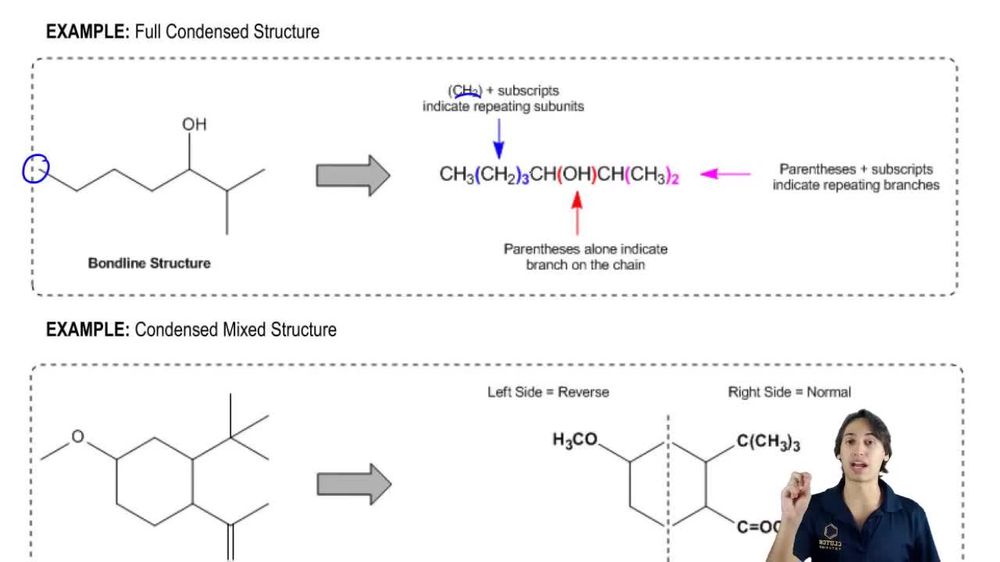
A condensed structural formula is a way of representing a chemical compound that shows the arrangement of atoms and the connectivity between them without depicting all the bonds explicitly. It typically groups atoms together to indicate how they are connected, making it easier to visualize the structure of organic molecules. For example, in methoxyethyne, the condensed formula would reflect the presence of both the methoxy group (-OCH3) and the ethyne (acetylene) structure.
Functional groups are specific groups of atoms within molecules that are responsible for the characteristic chemical reactions of those molecules. In the case of methoxyethyne, the methoxy group (-OCH3) is a functional group that influences the compound's reactivity and properties. Understanding functional groups is essential for predicting how a compound will behave in chemical reactions and for drawing accurate structures.
Alkynes are a class of hydrocarbons that contain at least one carbon-carbon triple bond. They are characterized by the general formula CnH2n-2 and exhibit unique properties and reactivity due to the presence of the triple bond. In the context of the question, sec-butyl-tert-butylacetylene involves alkynes, and recognizing the structure and behavior of alkynes is crucial for accurately drawing their condensed structures.

 5:27 minutes
 Verified step by step guidance
 06:06
06:06