Draw the condensed and skeletal structures for each of the following: a. 1-chloro-3-hexyne
Verified step by step guidance
1
Step 1: Understand the nomenclature of the compound. The name '1-chloro-3-hexyne' indicates that the molecule is a six-carbon chain (hex-) with a triple bond (-yne) starting at the third carbon and a chlorine atom attached to the first carbon.
Step 2: Begin by drawing the skeletal structure. Represent the six-carbon chain as a zigzag line, with the triple bond between the third and fourth carbons. Use a single line for single bonds and three parallel lines for the triple bond.
Step 3: Add the chlorine atom to the first carbon in the chain. Represent the chlorine atom as 'Cl' attached to the first carbon in the skeletal structure.
Step 4: For the condensed structure, write the molecular formula in a compact form. Start with the chlorine atom attached to the first carbon, followed by the chain of carbons and hydrogens. Indicate the triple bond between the third and fourth carbons explicitly.
Step 5: Double-check the structure to ensure it matches the IUPAC name. Verify that the chlorine is on the first carbon, the triple bond is between the third and fourth carbons, and the chain contains six carbons in total.
Verified video answer for a similar problem:
This video solution was recommended by our tutors as helpful for the problem above
Video duration:
5m
Play a video:
0 Comments
Key Concepts
Here are the essential concepts you must grasp in order to answer the question correctly.
Condensed Structures
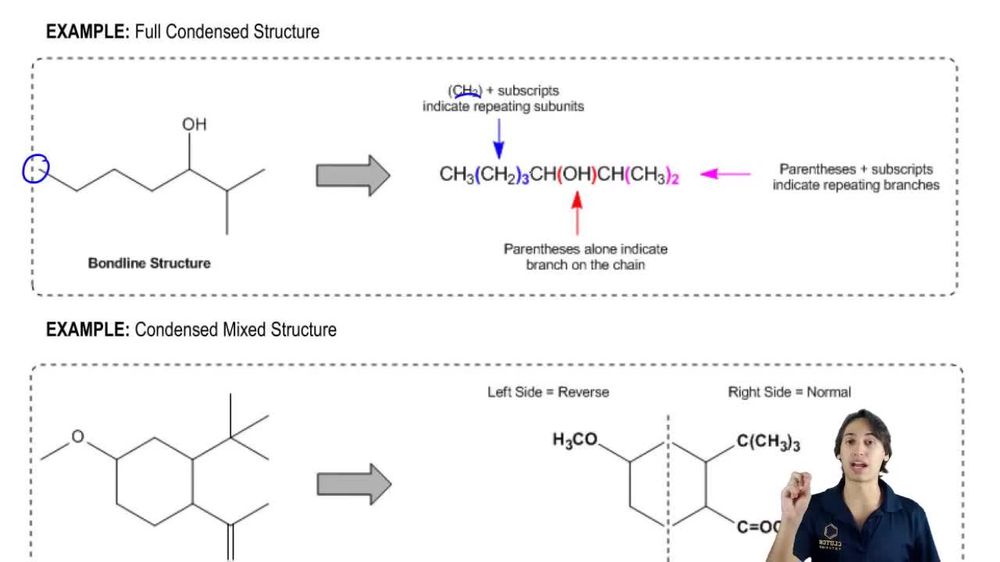
Condensed structures are a simplified way of representing organic molecules, where the connectivity of atoms is shown without depicting all the bonds explicitly. In these structures, groups of atoms are often grouped together, and hydrogen atoms attached to carbons are usually omitted for clarity. This format allows for a quick understanding of the molecular formula and the arrangement of functional groups.
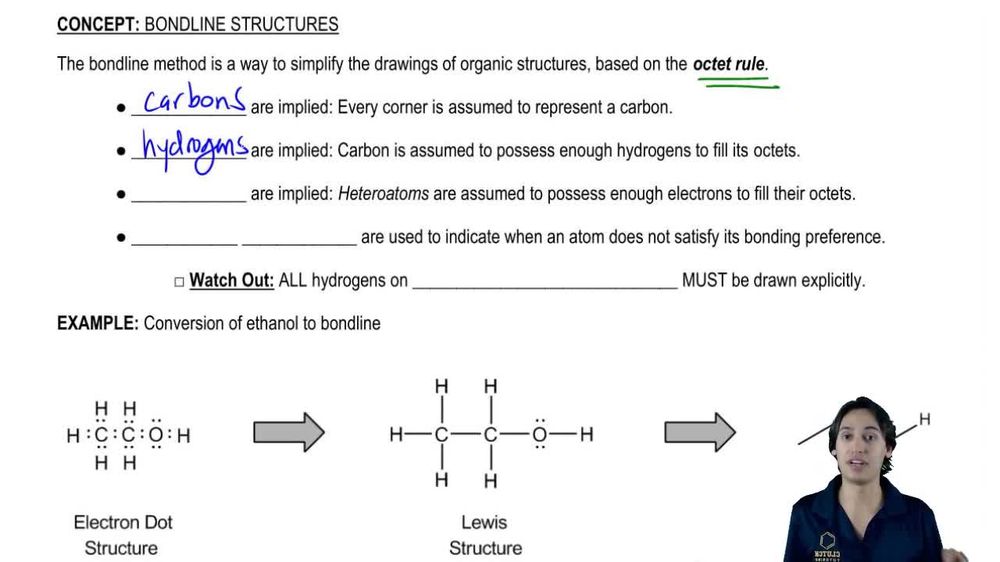
Skeletal structures, also known as line-angle structures, are a representation of organic molecules where carbon atoms are represented by vertices and lines represent bonds. Hydrogen atoms are typically not shown, as they are implied based on the tetravalency of carbon. This method is particularly useful for visualizing larger molecules and understanding their geometry and connectivity at a glance.
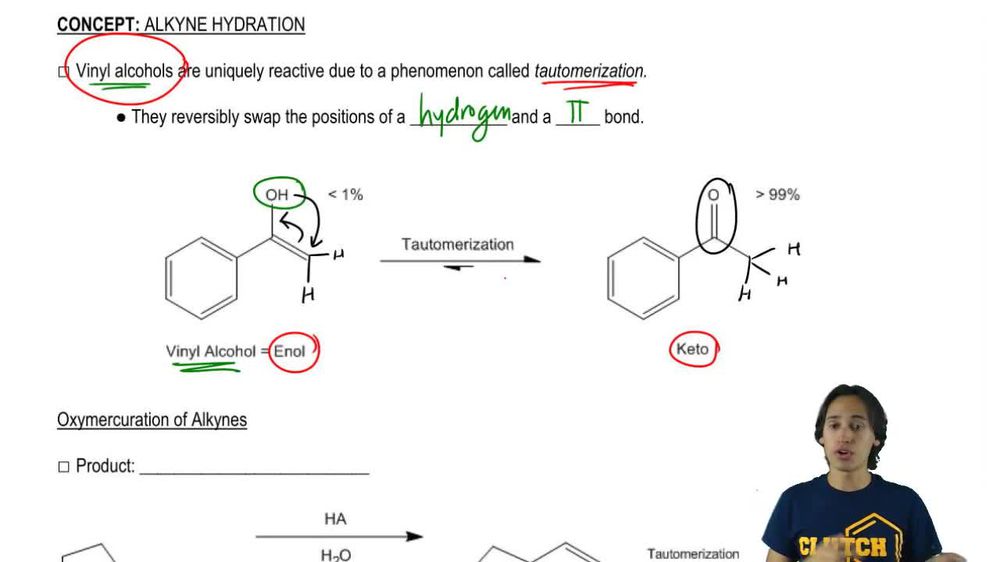
Alkynes are a class of hydrocarbons characterized by at least one carbon-carbon triple bond. They follow the general formula CnH2n-2, indicating that they are unsaturated compounds. The presence of the triple bond significantly influences the chemical reactivity and physical properties of alkynes, making them important in various organic reactions and synthesis.

 5:54 minutes
 Verified step by step guidance
 06:06
06:06