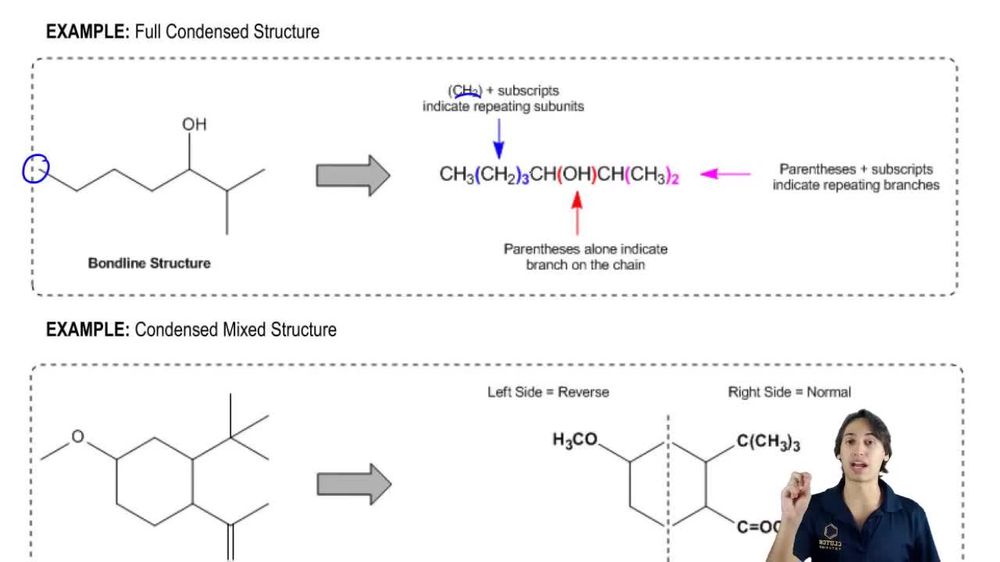
Draw a condensed structure for each of the following: a. 2-hexyne b. 5-ethyl-3-octyne
Verified step by step guidance
1
Step 1: Understand the naming conventions of alkynes. Alkynes are hydrocarbons containing a triple bond between two carbon atoms. The name indicates the position of the triple bond and any substituents attached to the main chain.
Step 2: For part (a), identify the structure of 2-hexyne. The 'hex-' prefix indicates a six-carbon chain, and the '2-' indicates the triple bond is located between the second and third carbons. Write the condensed structure starting with CH₃ for the first carbon, followed by CH for the second carbon (part of the triple bond), then C≡C for the triple bond, and finally CH₂ and CH₃ for the remaining carbons.
Step 3: For part (b), identify the structure of 5-ethyl-3-octyne. The 'oct-' prefix indicates an eight-carbon chain, and the '3-' indicates the triple bond is located between the third and fourth carbons. The '5-ethyl' indicates an ethyl group (-CH₂CH₃) is attached to the fifth carbon. Begin by writing the main chain with the triple bond at the correct position, then add the ethyl group to the fifth carbon.
Step 4: Ensure the condensed structures are written correctly. For 2-hexyne, the structure should reflect the six-carbon chain with the triple bond at the second position. For 5-ethyl-3-octyne, the structure should reflect the eight-carbon chain with the triple bond at the third position and the ethyl group attached to the fifth carbon.
Step 5: Double-check the structures for accuracy, ensuring the correct number of hydrogens are added to each carbon to satisfy the valency of carbon (four bonds per carbon atom).
Verified video answer for a similar problem:
This video solution was recommended by our tutors as helpful for the problem above
Video duration:
5m
Play a video:
0 Comments
Key Concepts
Here are the essential concepts you must grasp in order to answer the question correctly.
Alkynes
Alkynes are a class of hydrocarbons characterized by at least one carbon-carbon triple bond. They follow the general formula CnH2n-2, where 'n' is the number of carbon atoms. The presence of the triple bond gives alkynes unique properties, including increased reactivity compared to alkenes and alkanes. Understanding the structure and bonding in alkynes is essential for drawing their condensed structures.
A condensed structural formula is a way of representing a chemical structure that shows the arrangement of atoms in a molecule without depicting all the bonds explicitly. In this format, groups of atoms are often grouped together to simplify the representation. For example, in 2-hexyne, the condensed formula can be written as CH3C≡CCH2CH2CH3, indicating the positions of the triple bond and the carbon chain.
The nomenclature of organic compounds follows specific rules set by the International Union of Pure and Applied Chemistry (IUPAC). This system provides a standardized way to name compounds based on their structure, including the longest carbon chain, functional groups, and substituents. For instance, in 5-ethyl-3-octyne, the name indicates a carbon chain of eight carbons with an ethyl group at the fifth position and a triple bond starting at the third carbon.

 5:56 minutes
 Verified step by step guidance
 09:11
09:11