Draw the condensed and skeletal structures for each of the following: c. isopropylacetylene
Verified step by step guidance
1
Identify the structure of isopropylacetylene: Isopropylacetylene is a common name for a compound containing an isopropyl group (CH₃-CH-CH₃) attached to a triple bond (acetylene group, C≡CH). The IUPAC name for this compound is 3-methyl-1-butyne.
Start with the skeletal structure: Draw a triple bond (C≡C) to represent the acetylene group. Attach a single carbon atom to the terminal carbon of the triple bond to form the main chain.
Add the isopropyl group: Attach a branch consisting of two methyl groups (CH₃) to the second carbon of the main chain. This creates the isopropyl substituent.
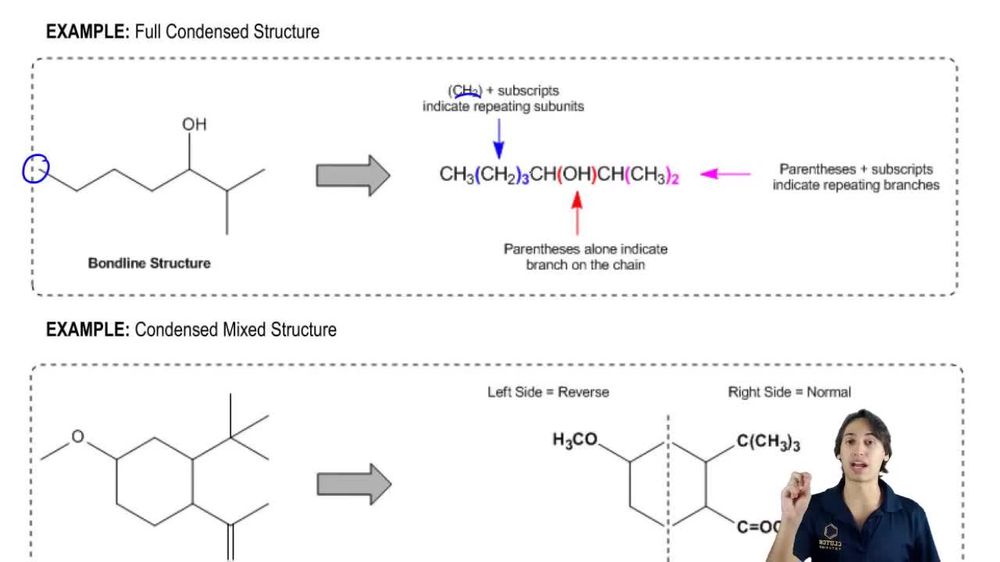
Draw the condensed structure: Write the condensed formula by grouping atoms together. For isopropylacetylene, the condensed structure is CH₃-C≡C-CH(CH₃)₂.
Verify the structure: Ensure that the skeletal and condensed structures correctly represent the connectivity of atoms and the presence of the triple bond and isopropyl group.
Verified video answer for a similar problem:
This video solution was recommended by our tutors as helpful for the problem above
Video duration:
6m
Play a video:
0 Comments
Key Concepts
Here are the essential concepts you must grasp in order to answer the question correctly.
Condensed Structures
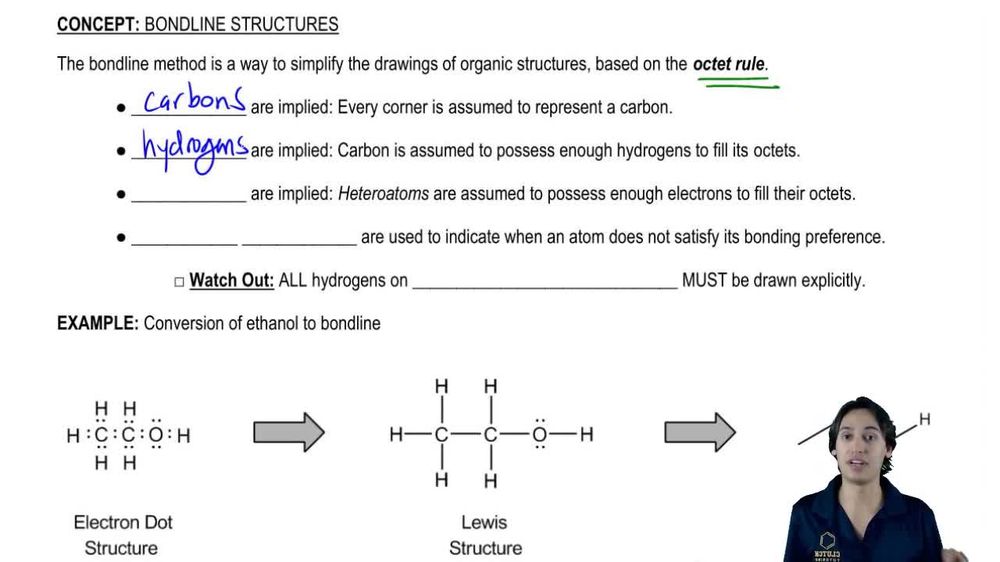
Condensed structures are a simplified way of representing molecular structures where atoms are grouped together to show connectivity without depicting all bonds explicitly. In these structures, carbon atoms are often listed in a linear format, and hydrogen atoms attached to them are implied rather than shown. This notation helps in quickly visualizing the molecular framework while maintaining clarity about the arrangement of atoms.
Skeletal structures, also known as line-angle structures, are a shorthand representation of organic molecules where carbon atoms are represented by vertices and hydrogen atoms are omitted for clarity. Each vertex represents a carbon atom, and the lines between them represent bonds. This method is particularly useful for complex molecules, as it allows chemists to easily visualize the overall shape and connectivity of the molecule without cluttering the diagram with hydrogen atoms.
Isopropylacetylene is an alkyne compound characterized by a triple bond between two carbon atoms, with an isopropyl group (a branched alkyl group) attached to one end. Its structure can be derived from acetylene by substituting one hydrogen atom with an isopropyl group. Understanding the structure of isopropylacetylene is essential for accurately drawing its condensed and skeletal forms, as it influences the overall geometry and reactivity of the molecule.

 6:40 minutes
 Verified step by step guidance
 06:06
06:06