Ch. 13 - Mass Spectrometry; Infrared Spectroscopy; UV/Vis Spectroscopy
Bruice - Organic Chemistry 8th Edition
Bruice8th EditionOrganic ChemistryISBN: 9780135213711Not the one you use?Change textbook
Chapter 14, Problem 60

The IR spectrum of compound A with a molecular formula of C5H12O is shown below. Compound A is oxidized to give compound B, a ketone with a molecular formula of C5H10O. When compound A is heated with H2SO4, compounds C and D are obtained. Considerably more D is obtained than C. Reaction of compound C with O3, followed by treatment with dimethyl sulfide, gives two products: formaldehyde and compound E, with a molecular formula of C4H8O. Reaction of compound D with O3, followed by treatment with dimethyl sulfide, gives two products: compound F, with a molecular formula of C3H6O, and compound G, with a molecular formula of C2H4O. What are the structures of compounds A through G?
<IMAGE>

Verified step by step guidance
1
Step 1: Analyze the molecular formula of compound A (C5H12O) and its IR spectrum. The presence of an -OH group can be inferred if there is a broad absorption around 3200-3600 cm⁻¹. This suggests that compound A is likely an alcohol.
Step 2: Consider the oxidation of compound A to compound B, which is a ketone (C5H10O). Oxidation of a secondary alcohol typically produces a ketone. This indicates that compound A is likely a secondary alcohol.
Step 3: Examine the dehydration reaction of compound A with H2SO4 to form compounds C and D. Dehydration of alcohols typically leads to alkenes. The fact that more of compound D is formed suggests that it is the more stable alkene, likely due to Zaitsev's rule (the more substituted alkene is favored).
Step 4: Analyze the ozonolysis of compound C. The products are formaldehyde (CH2O) and compound E (C4H8O). This indicates that compound C contains a terminal double bond, as ozonolysis cleaves double bonds to form carbonyl compounds.
Step 5: Analyze the ozonolysis of compound D. The products are compound F (C3H6O) and compound G (C2H4O). This suggests that compound D contains an internal double bond, as ozonolysis cleaves it to form two carbonyl compounds. Use the molecular formulas of the products to deduce the structure of compound D.

Verified video answer for a similar problem:

This video solution was recommended by our tutors as helpful for the problem above.
Video duration:
9m
Was this helpful?

Key Concepts

Here are the essential concepts you must grasp in order to answer the question correctly.

Infrared Spectroscopy (IR)

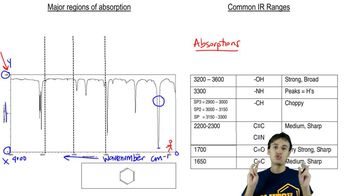
Infrared spectroscopy is a technique used to identify functional groups in organic compounds by measuring the absorption of infrared light. Different bonds absorb characteristic wavelengths of IR radiation, allowing chemists to deduce the presence of specific functional groups, such as alcohols, ketones, and alkenes, based on their unique absorption patterns.
Recommended video:
Guided course
16:04
General Features of IR Spect

Oxidation and Reduction in Organic Chemistry

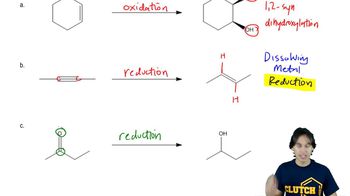
Oxidation in organic chemistry typically involves the loss of electrons or an increase in oxidation state, often resulting in the formation of carbonyl compounds like ketones or aldehydes. Understanding the oxidation states and the types of reactions that convert alcohols to ketones is crucial for predicting the transformations of compound A to compound B in the given question.
Recommended video:
Guided course
00:54
Distinguishing between Oxidation and Reduction

Ozonolysis

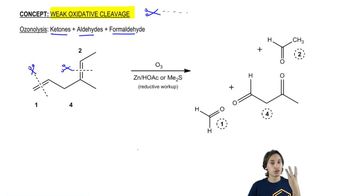
Ozonolysis is a reaction involving the cleavage of alkenes using ozone (O3), which results in the formation of carbonyl compounds. This reaction is significant for determining the structures of compounds C, D, F, and G, as it helps identify the products formed from the oxidative cleavage of double bonds, leading to smaller carbonyl-containing fragments.
Recommended video:
Guided course
06:30
General properties of ozonolysis.