Ch. 14 - Ethers, Epoxides, and Thioethers
Wade - Organic Chemistry 9th Edition
Wade9th EditionOrganic ChemistryISBN: 9780135213728Not the one you use?Change textbook
Chapter 14, Problem 45d

Show how you would synthesize the following ethers in good yield from the indicated starting materials and any additional reagents needed.
(d) 1-methoxydecane from a decene

Verified step by step guidance
1
Identify the starting material and the target product. The starting material is a decene (an alkene with 10 carbon atoms), and the target product is 1-methoxydecane (an ether with a methoxy group at the first carbon).
Recognize that the synthesis of ethers can be achieved using the Williamson ether synthesis, which involves the reaction of an alkoxide ion with an alkyl halide. However, in this case, we need to first convert the decene into a suitable intermediate.
Perform a hydroboration-oxidation reaction on the decene to convert the alkene into a primary alcohol. This involves two steps: (1) Hydroboration using BH₃ or a borane reagent, and (2) Oxidation using H₂O₂ and NaOH. The product will be 1-decanol.
Convert the 1-decanol into a suitable alkyl halide, such as 1-bromodecane, by reacting it with a halogenating agent like PBr₃ or SOCl₂. This step prepares the molecule for the Williamson ether synthesis.
React the 1-bromodecane with sodium methoxide (NaOCH₃), which is a strong nucleophile. The methoxide ion will perform an SN2 substitution on the 1-bromodecane, replacing the bromine atom with a methoxy group to form 1-methoxydecane.

Verified video answer for a similar problem:

This video solution was recommended by our tutors as helpful for the problem above.
Video duration:
3m
Was this helpful?

Key Concepts

Here are the essential concepts you must grasp in order to answer the question correctly.

Ethers and Their Synthesis

Ethers are organic compounds characterized by an oxygen atom connected to two alkyl or aryl groups. Their synthesis often involves the reaction of alcohols or alkenes with reagents such as alkyl halides or through methods like the Williamson ether synthesis. Understanding the reactivity of these compounds is crucial for designing effective synthetic routes.
Recommended video:
Guided course
03:50
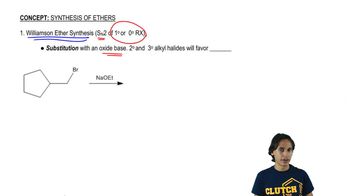
The Mechanism of Williamson Ether Synthesis.

Alkenes and Electrophilic Addition

Alkenes are hydrocarbons that contain at least one carbon-carbon double bond, making them reactive towards electrophiles. In the context of synthesizing ethers, alkenes can undergo electrophilic addition reactions to form more complex structures. Recognizing how to manipulate these reactions is essential for converting a decene into the desired ether.
Recommended video:
Guided course
09:23
1,2 vs 1,4 Addition

Nucleophilic Substitution Reactions

Nucleophilic substitution reactions involve the replacement of a leaving group by a nucleophile. In ether synthesis, this often occurs when an alcohol acts as a nucleophile, attacking an alkyl halide. Understanding the mechanisms of these reactions, including factors that influence their rates and outcomes, is vital for achieving good yields in ether synthesis.
Recommended video:
Guided course
01:47
Nucleophiles and Electrophiles can react in Substitution Reactions.