Ch.3 - Structure and Stereochemistry of Alkanes
Wade - Organic Chemistry 9th Edition
Wade9th EditionOrganic ChemistryISBN: 9780135213728Not the one you use?Change textbook
Chapter 3, Problem 12

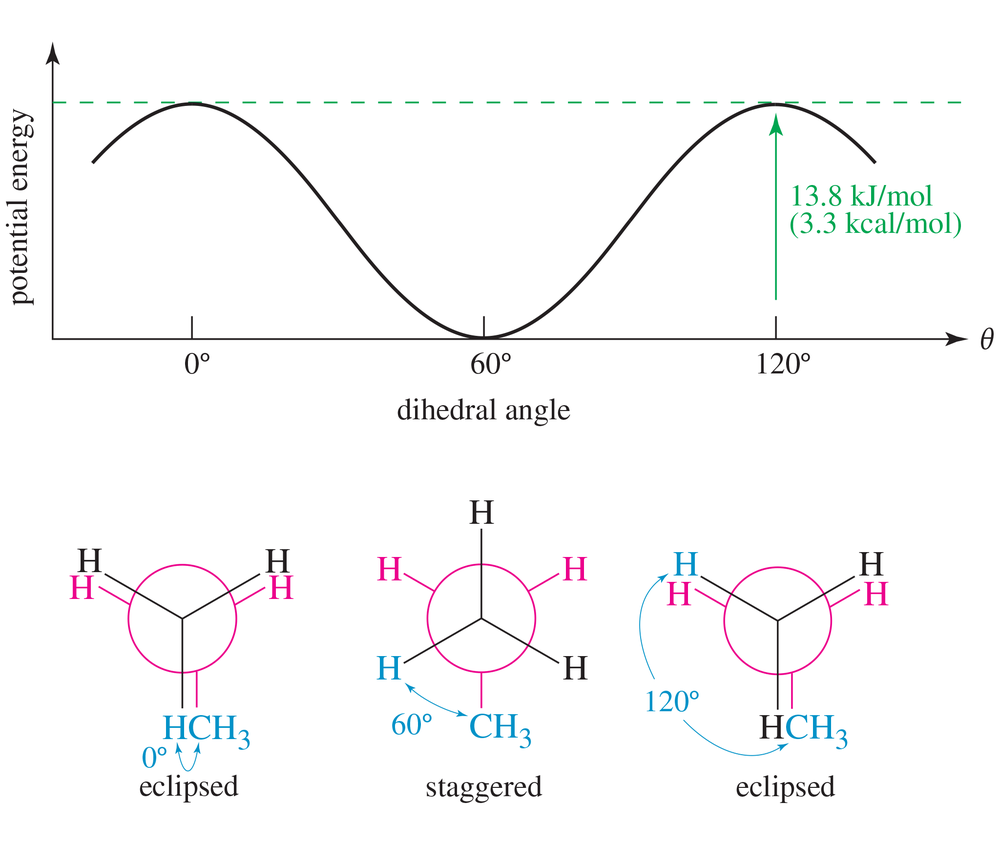
Draw a graph, similar to Figure 3-9, of the torsional strain of 2-methylpropane as it rotates about the bond between C1 and C2. Show the dihedral angle and draw a Newman projection for each staggered and eclipsed conformation.

Verified step by step guidance
1
Step 1: Understand the concept of torsional strain. Torsional strain arises due to the repulsion between electron clouds of bonds in eclipsed conformations. The potential energy changes as the molecule rotates about a bond, creating a graph similar to Figure 3-9.
Step 2: For part (a), draw a graph of torsional strain for 2-methylpropane as it rotates about the bond between C1 and C2. The graph will have peaks at eclipsed conformations (0°, 120°, 240°) and valleys at staggered conformations (60°, 180°, 300°). Label the dihedral angles and potential energy values appropriately.
Step 3: For part (b), identify the staggered and eclipsed conformations of 2-methylpropane. In staggered conformations, the bulky CH3 group is positioned to minimize repulsion with other groups. In eclipsed conformations, the CH3 group aligns with other groups, causing maximum torsional strain.
Step 4: Draw Newman projections for each conformation. For staggered conformations, show the CH3 group at 60°, 180°, and 300° dihedral angles relative to the hydrogen atoms. For eclipsed conformations, show the CH3 group at 0°, 120°, and 240° dihedral angles.
Step 5: Label each Newman projection with its corresponding dihedral angle and indicate whether it is staggered or eclipsed. Ensure the drawings clearly show the spatial arrangement of the CH3 group and hydrogen atoms around the C1-C2 bond.

Verified video answer for a similar problem:

This video solution was recommended by our tutors as helpful for the problem above.
Video duration:
4m
Was this helpful?

Key Concepts

Here are the essential concepts you must grasp in order to answer the question correctly.

Torsional Strain

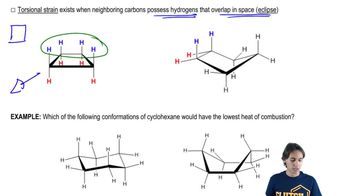
Torsional strain arises from the repulsion between electron clouds in adjacent bonds when they are eclipsed. In a molecule like 2-methylpropane, this strain is minimized in staggered conformations, where bonds are positioned 60° apart, compared to eclipsed conformations at 0° or 120°, which experience higher potential energy due to increased steric hindrance.
Recommended video:
Guided course
02:00
What is torsional strain?

Newman Projections

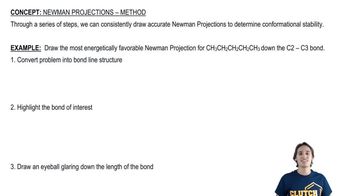
Newman projections are a way to visualize the conformation of a molecule by looking straight down the bond connecting two carbon atoms. This representation helps in identifying staggered and eclipsed conformations, allowing for a clearer understanding of torsional strain and the energy associated with different dihedral angles.
Recommended video:
Guided course
00:34
Introduction to Drawing Newman Projections

Potential Energy Diagram

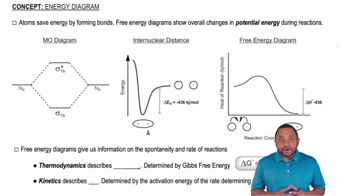
A potential energy diagram illustrates how the energy of a molecule changes with the dihedral angle during rotation about a bond. In the case of 2-methylpropane, the graph shows energy minima at staggered conformations and maxima at eclipsed conformations, quantifying the energy difference (13.8 kJ/mol) that indicates the stability of staggered arrangements over eclipsed ones.
Recommended video:
Guided course
06:07
Introduction to free energy diagrams.