Ch.3 - Structure and Stereochemistry of Alkanes
Wade - Organic Chemistry 9th Edition
Wade9th EditionOrganic ChemistryISBN: 9780135213728Not the one you use?Change textbook
Chapter 3, Problem 32

Use your models to do a chair–chair interconversion on each ring of the conformation of cis-decalin shown in Figure 3-27. Draw the conformation that results.

Verified step by step guidance
1
Identify the structure of cis-decalin from the image. Cis-decalin consists of two cyclohexane rings fused in such a way that the hydrogen atoms at the bridgehead carbons are on the same side of the molecule.
Understand the concept of chair–chair interconversion. This involves flipping the cyclohexane chair conformation, which changes axial positions to equatorial and vice versa.
Begin with the first cyclohexane ring. Perform a chair flip by inverting the positions of the substituents. Axial positions become equatorial, and equatorial positions become axial.
Repeat the chair flip process for the second cyclohexane ring. Ensure that the bridgehead hydrogens remain on the same side to maintain the cis configuration.
Draw the resulting conformation after both chair flips. The new conformation should still represent cis-decalin, with the bridgehead hydrogens on the same side, but with altered axial and equatorial positions for other substituents.

Verified video answer for a similar problem:

This video solution was recommended by our tutors as helpful for the problem above.
Video duration:
10m
Was this helpful?

Key Concepts

Here are the essential concepts you must grasp in order to answer the question correctly.

Chair Conformation

Chair conformation is a three-dimensional arrangement of carbon atoms in cyclohexane and its derivatives, where the carbon atoms adopt a staggered configuration. This minimizes steric strain and torsional strain, making it the most stable conformation. In the context of decalin, understanding chair conformations is crucial for visualizing how the rings can interconvert and how substituents are positioned.
Recommended video:
Guided course
03:29
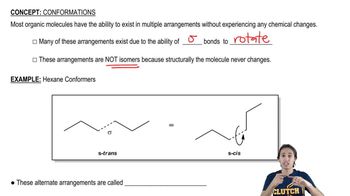
Understanding what a conformer is.

Cis-Trans Isomerism

Cis-trans isomerism refers to the spatial arrangement of substituents around a double bond or a ring structure. In cis-decalin, the two hydrogen atoms at the bridgehead carbons are on the same side of the ring system. This concept is essential for understanding the stereochemistry of decalin and how it affects the molecule's conformational flexibility during chair-chair interconversion.
Recommended video:
Guided course
00:44
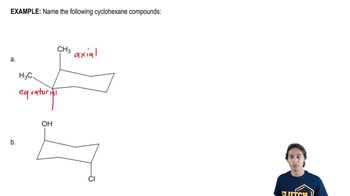
Is the following cyclohexane cis or trans?

Bridgehead Carbons

Bridgehead carbons are the carbon atoms located at the junction of two rings in a bicyclic compound. In cis-decalin, these carbons are critical for determining the molecule's conformation and stability. Their positioning influences the ability of the rings to undergo chair-chair interconversion, as the steric interactions and strain around these carbons dictate the preferred conformations.
Recommended video:
Guided course
02:12
Carbonation of Grignard Reagents