
Textbook Question
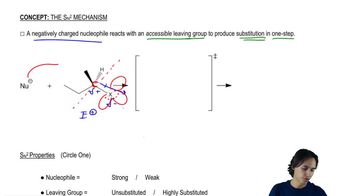
Show how you might use SN2 reactions to convert 1-chlorobutane into the following compounds.
c. 1-iodobutane
d. CH3—(CH2)3—CN
2004
views

 Verified step by step guidance
 08:27
08:27
 08:33
08:33 01:16
01:16Show how you might use SN2 reactions to convert 1-chlorobutane into the following compounds.
c. 1-iodobutane
d. CH3—(CH2)3—CN
For each pair, predict the stronger nucleophile in the SN2 reaction (using an alcohol as the solvent). Explain your prediction.
a. (CH3CH2)3N or (CH3CH2)2NH
b. (CH3)2O or (CH3)2S
For each pair, predict the stronger nucleophile in the SN2 reaction (using an alcohol as the solvent). Explain your prediction.
e. (CH3)3N or (CH3)2O
f. CH3COO– or CF3COO–
For each pair, predict the stronger nucleophile in the SN2 reaction (using an alcohol as the solvent). Explain your prediction.
g. (CH3)2CHO– or CH3CH2CH2O–
h. I– or Cl–
Show how you might use SN2 reactions to convert 1-chlorobutane into the following compounds.
e. CH3—(CH2)3—C≡CH
f. CH3CH2—O—(CH2)3—CH3
g. CH3—(CH2)3—NH2
When diethyl ether (CH3CH2OCH2CH3) is treated with concentrated HBr, the initial products are CH3CH2Br and CH3CH2OH. Propose a mechanism to account for this reaction.