

Hexamethylbenzene undergoes free-radical chlorination to give one monochlorinated product (C12H17Cl) and four dichlorinated products (C12H16Cl2). These products are easily separated by GC-MS, but the dichlorinated products are difficult to distinguish by their mass spectra. Draw the monochlorinated product and the four dichlorinated products, and explain how 13C NMR would easily distinguish among these compounds.
Different types of protons and carbons in alkanes tend to absorb at similar chemical shifts, making structure determination difficult. Explain how the 13C NMR spectrum, including the DEPT technique, would allow you to distinguish among the following four isomers.

Verified step by step guidance
Verified video answer for a similar problem:
Key Concepts
Nuclear Magnetic Resonance (NMR) Spectroscopy
Chemical Shifts
DEPT Technique
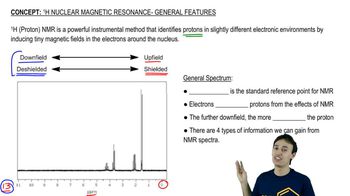
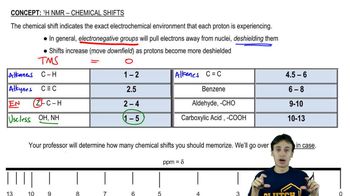
The three isomers of dimethylbenzene are commonly named ortho-xylene, meta-xylene, and para-xylene. These three isomers are difficult to distinguish using proton NMR, but they are instantly identifiable using 13C NMR.
(a) Describe how carbon NMR distinguishes these three isomers.
(b) Explain why they are difficult to distinguish using proton NMR.
(a) Draw all six isomers of formula C4H8 (including stereoisomers).
(b) For each structure, show how many types of H would appear in the proton NMR spectrum.
(c) For each structure, show how many types of C would appear in the 13C NMR spectrum.
(d) If an unknown compound of formula C4H8 shows two types of H and three types of C, can you determine its structure from this information?
Each of these four structures has molecular formula C4H8O2. Match the structure with its characteristic proton NMR signals. (Not all of the signals are listed in each case.)
(a) sharp 1H singlet at δ8.0 and 2H triplet at δ4.0
(b) sharp 3H singlet at δ2.0 and 2H quartet at δ4.1
(c) sharp 3H singlet at δ3.7 and 2H quartet at δ2.3
(d) broad 1H singlet at δ11.5 and 2H triplet at δ2.3
How many signals would you expect to see in the 13C NMR of the following compounds? In each case, show which carbon atoms are equivalent in the 13C NMR.
(A true story.) A major university was designated as a national nuclear magnetic resonance center by the National Science Foundation. Several large superconducting instruments were being installed when a government safety inspector appeared and demanded to know what provisions were being made to handle the nuclear waste produced by these instruments. Assume you are the manager of the NMR center, and offer an explanation that could be understood by a nonscientist.
