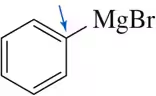
Calculate the oxidation numbers for the indicated atoms. (c)
Verified step by step guidance
1
Identify the structure: The compound shown is a Grignard reagent, specifically phenylmagnesium bromide, where the phenyl group (C6H5) is bonded to a magnesium bromide (MgBr). The arrow points to the carbon atom in the phenyl group that is directly bonded to the magnesium.
Understand the Grignard reagent: In Grignard reagents, the carbon atom bonded to the magnesium is considered to have a partial negative charge due to the polar covalent bond between carbon and magnesium. This is because magnesium is less electronegative than carbon.
Assign oxidation numbers: In organic compounds, carbon typically has an oxidation number of -4 to +4. For the carbon in the Grignard reagent, it is more electronegative than magnesium, so it 'takes' the electrons from the Mg-C bond, giving it an oxidation number of -1.
Consider the aromatic ring: The carbon atom in the phenyl group is part of an aromatic ring, which does not affect the oxidation number of the carbon directly bonded to magnesium. The aromaticity is maintained, and the oxidation number calculation focuses on the direct bond with magnesium.
Summarize the oxidation number: The oxidation number of the carbon atom indicated by the arrow in the Grignard reagent is -1, due to its bond with the less electronegative magnesium.
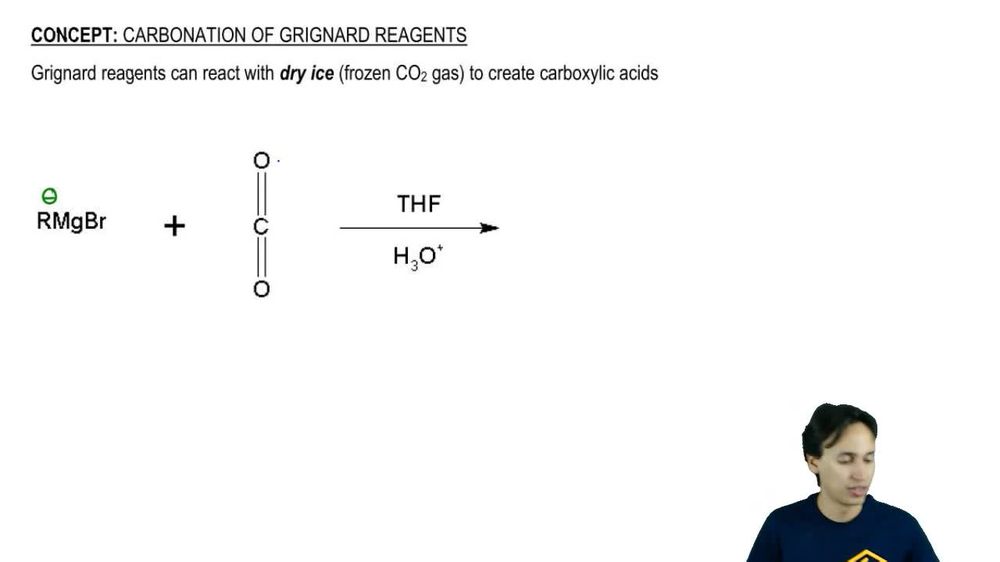
Verified video answer for a similar problem:
This video solution was recommended by our tutors as helpful for the problem above
Play a video:
0 Comments
Key Concepts
Here are the essential concepts you must grasp in order to answer the question correctly.
Oxidation Number
The oxidation number is a theoretical charge assigned to an atom in a molecule, representing the number of electrons lost or gained by the atom. It helps in determining the electron distribution in compounds and is crucial for redox reactions. In organic chemistry, it aids in understanding the electron flow in reactions involving organometallic compounds like Grignard reagents.
Grignard reagents are organomagnesium compounds typically represented as R-MgX, where R is an organic group and X is a halogen. They are highly reactive and used in forming carbon-carbon bonds. The magnesium atom in Grignard reagents often has a positive oxidation state, which is essential for understanding its reactivity and interaction with other molecules.
Electronegativity is the tendency of an atom to attract electrons towards itself in a chemical bond. It influences the oxidation number by affecting electron distribution in a molecule. In the context of the image, understanding the electronegativity difference between magnesium and bromine helps determine the oxidation state of magnesium in the MgBr group attached to the benzene ring.

 Verified step by step guidance
 03:40
03:40