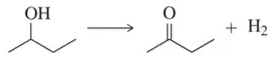
Use oxidation numbers to determine which of the following are redox reactions. (e)
Verified step by step guidance
1
Identify the reactants and products in the given chemical equation. The reactant is an alcohol, and the products are a ketone and hydrogen gas.
Assign oxidation numbers to each atom in the reactant. For the alcohol, the carbon bonded to the OH group typically has an oxidation number of -1, and the hydrogen atoms bonded to carbon have an oxidation number of +1.
Assign oxidation numbers to each atom in the products. In the ketone, the carbonyl carbon has an oxidation number of +1, and the hydrogen gas (H2) has an oxidation number of 0.
Compare the oxidation numbers of the carbon atom in the reactant and product. The carbon atom bonded to the OH group in the alcohol is oxidized from -1 to +1 in the ketone, indicating an increase in oxidation number.
Determine if a redox reaction has occurred. Since the oxidation number of carbon increases, and hydrogen is released as H2, this indicates that the alcohol is oxidized to a ketone, confirming a redox reaction.
Verified video answer for a similar problem:
This video solution was recommended by our tutors as helpful for the problem above
Play a video:
0 Comments
Key Concepts
Here are the essential concepts you must grasp in order to answer the question correctly.
Oxidation Numbers
Oxidation numbers are assigned to atoms in a molecule to indicate the degree of oxidation or reduction. They help track the transfer of electrons during chemical reactions. The rules for assigning oxidation numbers include that the oxidation state of an element in its standard state is zero, and for monoatomic ions, it equals the charge of the ion.
Redox reactions, or reduction-oxidation reactions, involve the transfer of electrons between two species. In these reactions, one species is oxidized (loses electrons) while another is reduced (gains electrons). Identifying redox reactions requires analyzing changes in oxidation numbers of the involved elements.
Balancing redox reactions involves ensuring that the number of electrons lost in oxidation equals the number gained in reduction. This can be done using half-reaction methods, where the oxidation and reduction processes are balanced separately before combining them. Proper balancing is crucial for accurately representing the stoichiometry of the reaction.

 Verified step by step guidance
 03:40
03:40