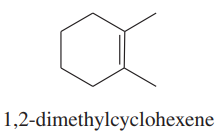
Using 1,2-dimethylcyclohexene as your starting material, show how you would synthesize the following compounds. (Once you have shown how to synthesize a compound, you may use it as the starting material in any later parts of this problem.) If a chiral product is shown, assume that it is part of a racemic mixture. (d)
Verified step by step guidance
1
Step 1: Begin with the starting material, 1,2-dimethylcyclohexene. The target compound has two hydroxyl groups added to the double bond in a syn fashion, meaning both OH groups are on the same side of the ring. This suggests a dihydroxylation reaction.
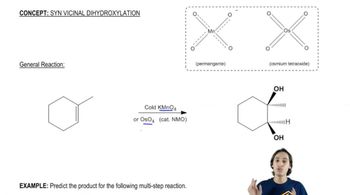
Step 2: Use a reagent combination that performs syn-dihydroxylation. A common choice is osmium tetroxide (OsO₄) in the presence of a co-oxidant such as N-methylmorpholine N-oxide (NMO). This reagent selectively adds two hydroxyl groups to the double bond in a syn manner.
Step 3: The reaction mechanism involves the formation of a cyclic osmate ester intermediate, which is then hydrolyzed to yield the diol product. Ensure that the stereochemistry of the product matches the target compound, with both OH groups on the same side of the ring.
Step 4: After the reaction, the product will be a racemic mixture because the starting material is achiral and the reaction introduces chirality. This is consistent with the problem statement that the product is part of a racemic mixture.
Step 5: Verify the structure of the product to ensure it matches the target compound, with the two hydroxyl groups and methyl groups positioned correctly on the cyclohexane ring.
Verified video answer for a similar problem:
This video solution was recommended by our tutors as helpful for the problem above
Video duration:
2m
Play a video:
0 Comments
Key Concepts
Here are the essential concepts you must grasp in order to answer the question correctly.
Electrophilic Addition Reactions
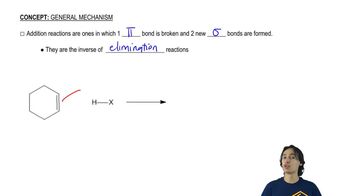
Electrophilic addition reactions are fundamental in organic chemistry, particularly for alkenes like 1,2-dimethylcyclohexene. In these reactions, an electrophile reacts with the double bond of the alkene, leading to the formation of a more stable carbocation intermediate. This process allows for the addition of various functional groups, such as halogens or hydroxyl groups, to the carbon atoms involved in the double bond.
Dihydroxylation is a specific type of electrophilic addition where two hydroxyl (OH) groups are added across a double bond. This reaction can be achieved through various methods, such as using osmium tetroxide or potassium permanganate. The result is a diol, which can be either a syn or anti addition depending on the reaction conditions, and is crucial for synthesizing compounds with multiple functional groups.
General properties of syn vicinal dihydroxylation.
Stereochemistry and Chirality
Stereochemistry refers to the spatial arrangement of atoms in molecules and is essential in understanding the properties of chiral compounds. A chiral molecule has non-superimposable mirror images, leading to enantiomers that can exhibit different biological activities. In the context of the synthesis question, recognizing the potential for chirality in the products is vital, especially when dealing with racemic mixtures, which contain equal amounts of both enantiomers.