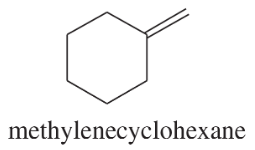
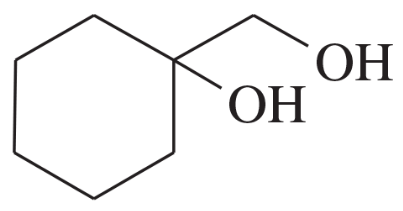
Show how you would synthesize each compound using methylenecyclohexane as your starting material. (f)
Verified step by step guidance
1
Step 1: Begin with methylenecyclohexane as the starting material. This compound contains a double bond, which can be used for functional group transformations.
Step 2: Perform a dihydroxylation reaction to add two hydroxyl groups (-OH) across the double bond. Use a reagent such as osmium tetroxide (OsO₄) in the presence of a co-oxidant like N-methylmorpholine N-oxide (NMO) or potassium permanganate (KMnO₄) under mild conditions.
Step 3: Ensure the reaction proceeds with syn addition, meaning both hydroxyl groups will add to the same side of the double bond, resulting in a cis-1,2-diol.
Step 4: After the reaction, isolate and purify the product using techniques such as extraction and recrystallization to obtain the desired compound.
Step 5: Confirm the structure of the synthesized compound using spectroscopic methods such as NMR (nuclear magnetic resonance) and IR (infrared spectroscopy) to verify the presence of the hydroxyl groups and the diol structure.
Verified video answer for a similar problem:
This video solution was recommended by our tutors as helpful for the problem above
Video duration:
1m
Play a video:
0 Comments
Key Concepts
Here are the essential concepts you must grasp in order to answer the question correctly.
Synthesis in Organic Chemistry
Synthesis in organic chemistry refers to the process of constructing complex organic compounds from simpler ones. This involves a series of chemical reactions that transform starting materials into desired products, often requiring knowledge of reaction mechanisms, functional group transformations, and the use of reagents. Understanding synthesis is crucial for designing pathways to create specific compounds, such as those derived from methylenecyclohexane.
Functional groups are specific groups of atoms within molecules that are responsible for the characteristic chemical reactions of those molecules. In the context of the question, the presence of hydroxyl (OH) groups in the target compounds indicates that the synthesis will involve reactions that introduce or modify these functional groups. Recognizing and manipulating functional groups is essential for predicting the behavior of organic compounds during synthesis.
Reaction mechanisms describe the step-by-step sequence of elementary reactions by which overall chemical change occurs. Understanding these mechanisms is vital for predicting the products of reactions involving methylenecyclohexane, as it allows chemists to anticipate how different reagents will interact with the starting material. Knowledge of mechanisms also aids in optimizing conditions for desired outcomes in synthetic pathways.