Predict the major products of the following reactions, including stereochemistry. e. trans-pent-2-ene + OsO4/H2O2
Verified step by step guidance
1
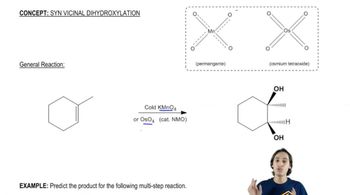
Step 1: Recognize the type of reaction. The reaction involves trans-pent-2-ene, a trans-alkene, reacting with osmium tetroxide (OsO4) followed by hydrogen peroxide (H2O2). This is a dihydroxylation reaction, which adds two hydroxyl (-OH) groups to the double bond in a syn fashion.
Step 2: Analyze the stereochemistry of the starting material. Trans-pent-2-ene has the two substituents on opposite sides of the double bond. This stereochemistry will influence the spatial arrangement of the hydroxyl groups in the product.
Step 3: Understand the mechanism. OsO4 reacts with the double bond to form a cyclic osmate ester intermediate. This intermediate ensures that the two hydroxyl groups are added to the same face of the alkene (syn addition).
Step 4: Consider the role of H2O2. Hydrogen peroxide is used in the second step to hydrolyze the osmate ester, releasing the diol product with the hydroxyl groups added syn to each other.
Step 5: Predict the major product. The major product will be a syn-diol, where the two hydroxyl groups are added to the same side of the original double bond. Since the starting material is trans-pent-2-ene, the stereochemistry of the product will reflect the syn addition relative to the trans configuration of the alkene.
Verified video answer for a similar problem:
This video solution was recommended by our tutors as helpful for the problem above
Video duration:
2m
Play a video:
0 Comments
Key Concepts
Here are the essential concepts you must grasp in order to answer the question correctly.
Stereochemistry
Stereochemistry refers to the study of the spatial arrangement of atoms in molecules and how this affects their chemical behavior. In reactions, stereochemistry is crucial for predicting the configuration of products, especially in cases involving double bonds or chiral centers. Understanding concepts like cis/trans isomerism helps in determining the stereochemical outcome of reactions.
Dihydroxylation is a chemical reaction that involves the addition of two hydroxyl (–OH) groups across a double bond. In the case of trans-pent-2-ene reacting with OsO4/H2O2, this reaction leads to the formation of a vicinal diol. The choice of reagents influences the stereochemical outcome, typically resulting in syn addition, where both hydroxyl groups are added to the same side of the double bond.
General properties of syn vicinal dihydroxylation.
Oxidation Reactions
Oxidation reactions involve the loss of electrons or an increase in oxidation state, often accompanied by the addition of oxygen or the removal of hydrogen. In organic chemistry, reagents like osmium tetroxide (OsO4) are used for selective oxidation of alkenes, leading to the formation of diols. Understanding the mechanism of these reactions is essential for predicting the products and their stereochemistry.