How could the following compounds be synthesized using a Diels–Alder reaction? c.
Verified step by step guidance
1
Step 1: Identify the product structure. The given compound is a cyclohexene derivative with a ketone functional group attached to the 2-position. This suggests that the compound could be synthesized via a Diels–Alder reaction, which forms a six-membered ring.
Step 2: Recall the Diels–Alder reaction mechanism. It involves a conjugated diene reacting with a dienophile to form a cyclohexene ring. The ketone group in the product indicates that the dienophile must contain a carbonyl group.
Step 3: Determine the diene. The cyclohexene ring in the product suggests that the diene should be a conjugated system, such as 1,3-butadiene, which can form the six-membered ring upon reaction.
Step 4: Determine the dienophile. The ketone group in the product suggests that the dienophile should be an α,β-unsaturated carbonyl compound, such as methyl vinyl ketone (CH2=CH-COCH3). This structure allows the carbonyl group to be incorporated into the final product.
Step 5: Combine the diene and dienophile. In the Diels–Alder reaction, 1,3-butadiene reacts with methyl vinyl ketone to form the cyclohexene ring with the ketone group at the 2-position. Ensure the reaction conditions are appropriate, typically involving heat or a Lewis acid catalyst to facilitate the cycloaddition.
Verified video answer for a similar problem:
This video solution was recommended by our tutors as helpful for the problem above
Video duration:
1m
Play a video:
0 Comments
Key Concepts
Here are the essential concepts you must grasp in order to answer the question correctly.
Diels–Alder Reaction
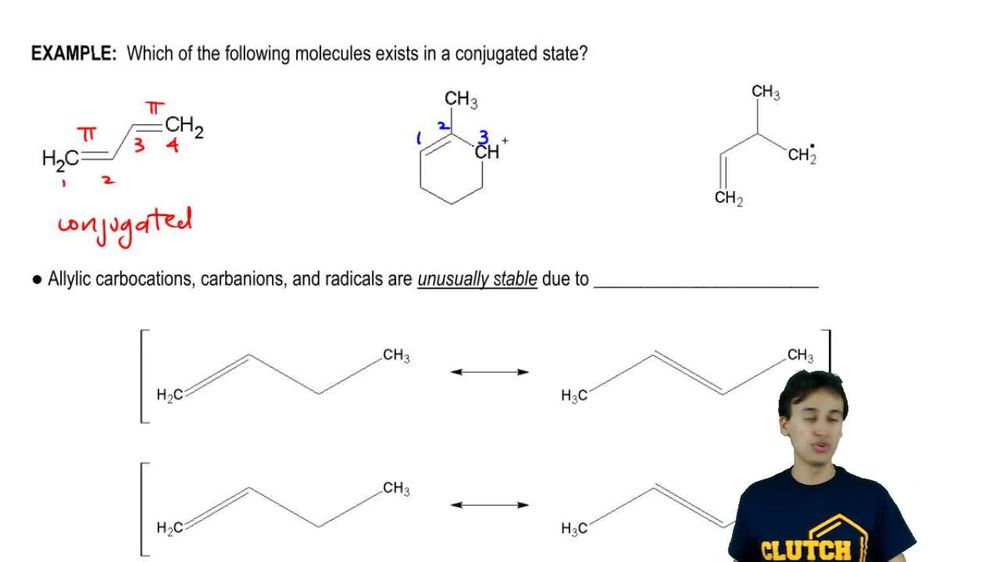
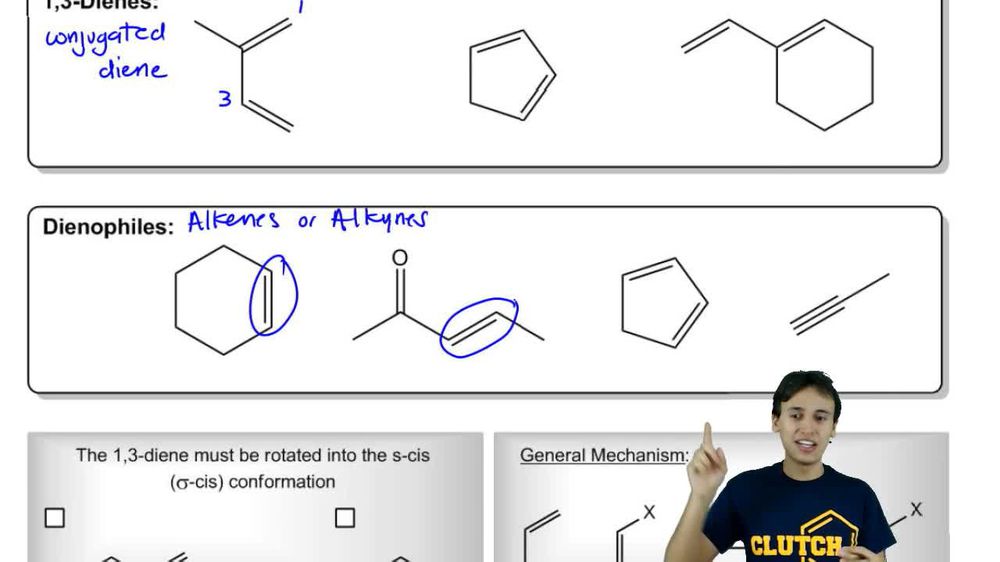
The Diels–Alder reaction is a [4+2] cycloaddition reaction between a conjugated diene and a dienophile, resulting in the formation of a six-membered ring. This reaction is a key method in organic synthesis due to its ability to create complex cyclic structures with high stereoselectivity and regioselectivity. Understanding the mechanism, which involves the formation of a cyclic transition state, is crucial for predicting the products formed.
Conjugated dienes are compounds that contain two double bonds separated by a single bond, allowing for delocalization of π electrons. This delocalization enhances the reactivity of the diene in the Diels–Alder reaction, making it more nucleophilic. Recognizing the structure and stability of conjugated dienes is essential for determining their suitability as reactants in cycloaddition reactions.
A dienophile is an electron-deficient alkene or alkyne that reacts with a diene in the Diels–Alder reaction. The reactivity of the dienophile is influenced by substituents that can either withdraw or donate electron density, affecting the overall reaction rate and product formation. Identifying suitable dienophiles is critical for successfully synthesizing desired compounds through this reaction.

 1:53 minutes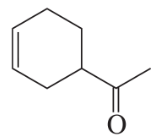
 Verified step by step guidance
 04:02
04:02