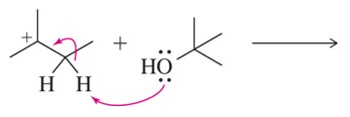
Identify the arrows shown by type and predict the product that should result. (e)
Verified step by step guidance
1
Step 1: Analyze the reaction mechanism shown in the image. The first arrow indicates the movement of a pair of electrons from the hydroxide ion (HO⁻) to the positively charged carbon atom in the tertiary carbocation. This is a nucleophilic attack, where the hydroxide ion acts as the nucleophile.
Step 2: The second arrow shows the movement of a hydrogen atom (proton transfer) from the hydroxide ion to the adjacent carbon atom. This step stabilizes the intermediate and completes the reaction.
Step 3: Predict the product based on the reaction mechanism. The nucleophilic attack by the hydroxide ion will result in the formation of a new bond between the oxygen atom and the positively charged carbon atom.
Step 4: The proton transfer will result in the removal of one hydrogen atom from the hydroxide ion, converting it into a neutral alcohol group (-OH).
Step 5: The final product will be a tertiary alcohol, where the hydroxyl group (-OH) is attached to the carbon atom that was initially part of the carbocation.
Verified video answer for a similar problem:
This video solution was recommended by our tutors as helpful for the problem above
Play a video:
0 Comments
Key Concepts
Here are the essential concepts you must grasp in order to answer the question correctly.
Reaction Mechanisms
Reaction mechanisms describe the step-by-step process by which reactants transform into products. Understanding the mechanism helps predict the outcome of a reaction, including the types of intermediates formed and the overall energy changes. Key components include nucleophiles, electrophiles, and the role of catalysts.
Arrow notation is used to illustrate the movement of electrons during chemical reactions. Curved arrows indicate the flow of electron pairs, showing how bonds are formed or broken. Understanding this notation is crucial for visualizing reaction pathways and predicting products.
Organic reactions can be classified into several types, including substitution, addition, elimination, and rearrangement reactions. Each type has distinct characteristics and mechanisms. Recognizing the type of reaction occurring is essential for predicting the products and understanding the underlying chemistry.

 Verified step by step guidance
 02:16
02:16