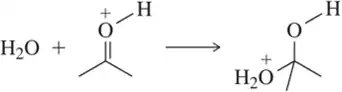
Show an arrow-pushing mechanism that forms the product on the right from the reactant at left. Two arrows are necessary in each reaction. (b)
Verified step by step guidance
1
Step 1: Identify the reactants and products. The reactant is a protonated ketone (with a positively charged oxygen atom) and water (H₂O). The product is a hydrated form of the ketone, where water has added to the carbonyl group.
Step 2: Recognize the mechanism type. This is an acid-catalyzed hydration reaction, where water acts as a nucleophile and attacks the electrophilic carbonyl carbon.
Step 3: First arrow-pushing step: Draw an arrow from the lone pair of electrons on the oxygen atom of water (H₂O) to the carbonyl carbon of the protonated ketone. This represents the nucleophilic attack of water on the carbonyl carbon.
Step 4: Second arrow-pushing step: Draw an arrow from the double bond of the carbonyl group to the positively charged oxygen atom. This represents the breaking of the π bond and the formation of a single bond between the carbon and oxygen.
Step 5: Final structure: The product is formed with the addition of water to the carbonyl group, resulting in a hydrated structure where the oxygen atom of water is now bonded to the carbonyl carbon, and the original oxygen atom retains its positive charge.
Verified video answer for a similar problem:
This video solution was recommended by our tutors as helpful for the problem above
Play a video:
0 Comments
Key Concepts
Here are the essential concepts you must grasp in order to answer the question correctly.
Arrow-Pushing Mechanism
Arrow-pushing mechanisms are diagrams used in organic chemistry to illustrate the movement of electrons during chemical reactions. The arrows indicate the direction of electron flow, showing how bonds are formed or broken. Understanding this mechanism is crucial for predicting the products of reactions and visualizing the transition states.
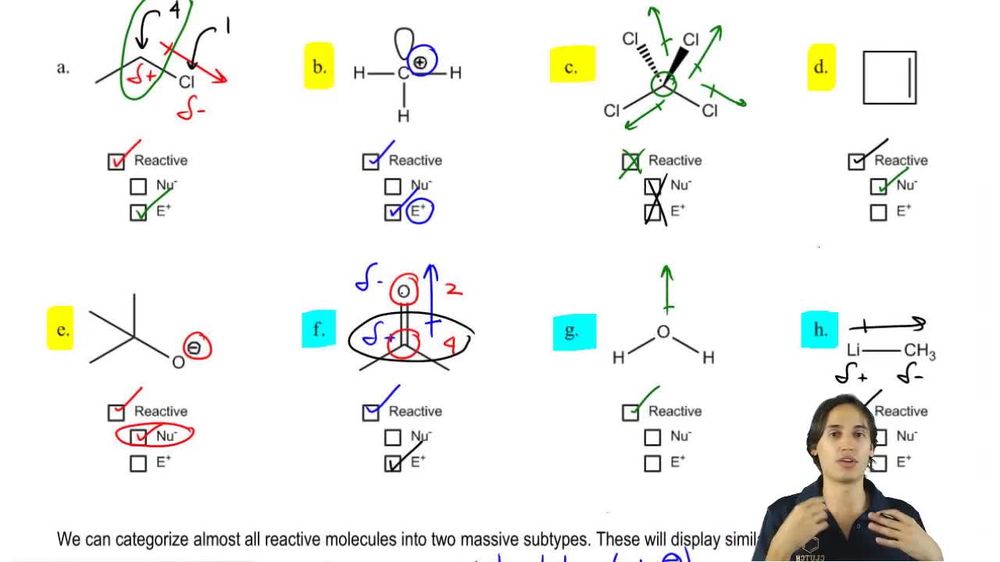
Nucleophiles are species that donate an electron pair to form a chemical bond, while electrophiles are electron-deficient species that accept an electron pair. Recognizing the roles of nucleophiles and electrophiles in a reaction is essential for determining how reactants interact and what products are formed. This concept is fundamental in understanding reaction mechanisms.
Reaction intermediates are transient species that form during the conversion of reactants to products. They are often unstable and exist only for a short time. Identifying these intermediates can provide insight into the steps of a reaction mechanism and help predict the final products, making them a key aspect of understanding complex organic reactions.