Ch. 21 - Conjugated Systems I: Stability and Addition Reactions
Mullins - Organic Chemistry: A Learner Centered Approach 1st Edition
Mullins1st EditionOrganic Chemistry: A Learner Centered ApproachISBN: 9780137566471Not the one you use?Change textbook
Chapter 20, Problem 7

To this point, hydrogenation has always been an exothermic process. Using the numbers from Fig­ure 21.6, calculate ∆Hohydr for each step of the reduction of benzene. Benzene hydrogenation steps with unknown enthalpy changes labeled as ΔH₁, ΔH₂, and ΔH₃.
∆H1 + ∆H2 + ∆H3 = ∆Htot = ―49.5 kcal /mol (―208 kJ/mol)

Verified step by step guidance
1
Step 1: Understand the problem. The hydrogenation of benzene occurs in three steps, each involving the addition of H₂ to reduce one double bond. The total enthalpy change (∆Htot) for the complete reduction of benzene to cyclohexane is given as -49.5 kcal/mol (-208 kJ/mol). We need to calculate the enthalpy change (∆H₁, ∆H₂, ∆H₃) for each step.
Step 2: Recognize that the total enthalpy change is the sum of the enthalpy changes for each step: ∆H₁ + ∆H₂ + ∆H₃ = ∆Htot. This equation will guide the calculation.
Step 3: Note that benzene has resonance stabilization energy, which makes the first hydrogenation step (∆H₁) less exothermic compared to the subsequent steps. This is because breaking the aromaticity of benzene requires additional energy.
Step 4: Use the data from Figure 21.6 (if available) to determine the individual enthalpy changes for ∆H₁, ∆H₂, and ∆H₃. If the values for ∆H₁ or any other step are provided in Section 23.2.1, use them to solve for the remaining enthalpy changes.
Step 5: Rearrange the equation ∆H₁ + ∆H₂ + ∆H₃ = ∆Htot to solve for the unknown values. For example, if ∆H₁ is known, subtract it from ∆Htot to find the sum of ∆H₂ and ∆H₃, and then use additional data to determine their individual values.

Verified video answer for a similar problem:

This video solution was recommended by our tutors as helpful for the problem above.
Video duration:
8m
Was this helpful?

Key Concepts

Here are the essential concepts you must grasp in order to answer the question correctly.

Hydrogenation

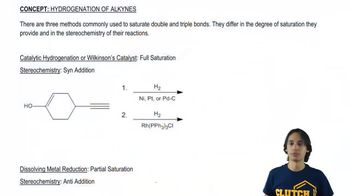
Hydrogenation is a chemical reaction that involves the addition of hydrogen (H₂) to an unsaturated compound, typically alkenes or alkynes, converting them into saturated hydrocarbons. In the context of benzene, hydrogenation reduces the aromatic ring to form cyclohexane. This process is generally exothermic, meaning it releases energy, which is crucial for calculating the enthalpy changes involved.
Recommended video:
Guided course
00:48
The definition of hydrogenation.

Enthalpy Change (ΔH)

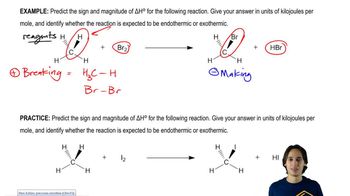
Enthalpy change (ΔH) is a measure of the heat content of a system at constant pressure. It indicates whether a reaction is exothermic (releases heat, ΔH < 0) or endothermic (absorbs heat, ΔH > 0). In the hydrogenation of benzene, the total enthalpy change is the sum of the individual steps (ΔH₁, ΔH₂, ΔH₃), which must equal the overall change provided in the question.
Recommended video:
Guided course
04:38
Calculating Enthalpies

Thermochemical Equations

Thermochemical equations represent the relationship between the heat absorbed or released during a chemical reaction and the stoichiometry of the reaction. They allow for the calculation of enthalpy changes for each step in a multi-step reaction, such as the hydrogenation of benzene. By knowing the total enthalpy change and the individual steps, one can solve for the unknown enthalpy changes (ΔH₁, ΔH₂, ΔH₃) in the reaction sequence.
Recommended video:
Guided course
05:02
Breaking down the different terms of the Gibbs Free Energy equation.