Predict the major products of the following reactions. f. 1-ethylcycloheptene + cold, dilute KMnO4
Verified step by step guidance
1
Identify the type of reaction: Cold, dilute KMnO4 is a reagent used for syn-dihydroxylation of alkenes. This reaction adds two hydroxyl (-OH) groups across the double bond in a syn (same side) fashion.
Locate the double bond in the given molecule: 1-ethylcycloheptene contains a double bond in the cycloheptene ring. The double bond is the site of the reaction.
Determine the stereochemistry of the addition: Since cold, dilute KMnO4 performs syn addition, the two hydroxyl groups will be added to the same face of the double bond.
Draw the intermediate structure: Break the π-bond of the double bond and add one hydroxyl group to each of the two carbons that were part of the double bond. Ensure that both hydroxyl groups are on the same side of the ring.
Verify the product: Confirm that the product is a 1,2-diol (vicinal diol) with the hydroxyl groups added in a syn fashion. The ethyl group on the cycloheptene ring remains unchanged.
Verified video answer for a similar problem:
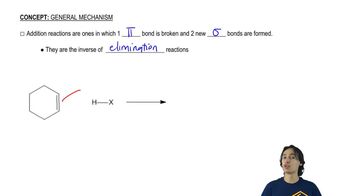
This video solution was recommended by our tutors as helpful for the problem above
Video duration:
3m
Play a video:
0 Comments
Key Concepts
Here are the essential concepts you must grasp in order to answer the question correctly.
Electrophilic Addition Reactions
Electrophilic addition reactions involve the addition of electrophiles to alkenes, where the double bond acts as a nucleophile. In the case of 1-ethylcycloheptene, the double bond can react with cold, dilute KMnO4, which serves as an electrophile, leading to the formation of a diol through syn-dihydroxylation.
Oxidation reactions in organic chemistry refer to the process where a molecule loses electrons, often involving the addition of oxygen or the removal of hydrogen. KMnO4 is a strong oxidizing agent, and in cold, dilute conditions, it selectively oxidizes alkenes to form vicinal diols, which are compounds with hydroxyl groups on adjacent carbon atoms.
Regioselectivity refers to the preference of a chemical reaction to yield one structural isomer over others, while stereochemistry deals with the spatial arrangement of atoms in molecules. In the reaction of 1-ethylcycloheptene with KMnO4, the regioselectivity will determine which carbon atoms are oxidized, and the stereochemistry will dictate whether the resulting diol is formed in a syn or anti manner.