Using 1,2-dimethylcyclohexene as your starting material, show how you would synthesize the following compounds. (Once you have shown how to synthesize a compound, you may use it as the starting material in any later parts of this problem.) If a chiral product is shown, assume that it is part of a racemic mixture. (e)
Verified step by step guidance
1
Step 1: Begin with the starting material, 1,2-dimethylcyclohexene. This compound contains a double bond, which can be used for addition reactions to introduce functional groups.
Step 2: To synthesize the target compound, which is a diol (two hydroxyl groups on adjacent carbons), perform a syn-dihydroxylation reaction. Use a reagent such as osmium tetroxide (OsO₄) in the presence of a co-oxidant like N-methylmorpholine N-oxide (NMO) or potassium permanganate (KMnO₄) under mild conditions.
Step 3: The syn-dihydroxylation reaction will add two hydroxyl groups to the double bond in a syn fashion, meaning both hydroxyl groups will be added to the same face of the cyclohexane ring. This ensures the stereochemistry of the product matches the target compound.
Step 4: After the reaction, the product will be a racemic mixture of the diol, as the reaction does not favor one enantiomer over the other. This is consistent with the problem statement that assumes a racemic mixture for chiral products.
Step 5: Verify the structure of the product to ensure it matches the target compound, with hydroxyl groups on adjacent carbons and the correct stereochemistry (both groups on the same face of the ring).
Verified video answer for a similar problem:
This video solution was recommended by our tutors as helpful for the problem above
Video duration:
2m
Play a video:
0 Comments
Key Concepts
Here are the essential concepts you must grasp in order to answer the question correctly.
Electrophilic Addition Reactions
Electrophilic addition reactions are fundamental in organic chemistry, particularly for alkenes like 1,2-dimethylcyclohexene. In these reactions, an electrophile reacts with the double bond of the alkene, leading to the formation of a more saturated product. Understanding this concept is crucial for synthesizing compounds from alkenes, as it allows for the introduction of various functional groups, such as alcohols or halides, into the molecule.
Stereochemistry involves the study of the spatial arrangement of atoms in molecules and how this affects their chemical behavior. In the context of the question, the presence of chiral centers in the products means that stereochemical considerations are essential. Recognizing how reactions can lead to different stereoisomers, including racemic mixtures, is vital for predicting the outcomes of synthetic pathways.
Functional group transformations refer to the chemical reactions that convert one functional group into another. In the synthesis of compounds from 1,2-dimethylcyclohexene, understanding how to manipulate functional groups—such as converting alkenes to alcohols through hydration—is key. This concept is foundational for designing synthetic routes and predicting the reactivity of different functional groups in organic molecules.

 2:15 minutes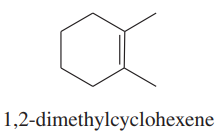

 Verified step by step guidance
 05:39
05:39

