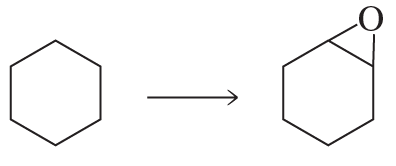
Design a multistep synthesis to show how the following compounds can be prepared from the given starting material: a.
Verified step by step guidance
1
Step 1: Begin with the starting material, cyclopentane. Introduce a halogen atom (e.g., bromine) to the molecule by performing a free radical halogenation reaction using Br₂ and light (hv). This will yield bromocyclopentane.
Step 2: Convert bromocyclopentane into cyclopentanol by performing a nucleophilic substitution reaction (SN2) using aqueous NaOH. The hydroxide ion will replace the bromine atom, forming cyclopentanol.
Step 3: Oxidize cyclopentanol to cyclopentanone using an oxidizing agent such as PCC (Pyridinium Chlorochromate) or Jones reagent (CrO₃/H₂SO₄). This step converts the alcohol group into a ketone group.
Step 4: Perform a Baeyer-Villiger oxidation on cyclopentanone using a peracid such as mCPBA (meta-Chloroperoxybenzoic acid). This reaction inserts an oxygen atom adjacent to the carbonyl group, forming the desired lactone (cyclic ester).
Step 5: Verify the structure of the product to ensure it matches the target compound, which is a cyclic ester derived from cyclopentanone.
Verified video answer for a similar problem:
This video solution was recommended by our tutors as helpful for the problem above
Video duration:
5m
Play a video:
0 Comments
Key Concepts
Here are the essential concepts you must grasp in order to answer the question correctly.
Cycloalkane Reactivity
Cycloalkanes, such as cyclohexane, are saturated hydrocarbons that can undergo various reactions, including substitution and elimination. Understanding their reactivity is crucial for designing synthetic pathways, as these reactions can lead to the formation of more complex structures, such as bicyclic compounds. The stability and strain of the ring structure also influence the types of reactions that can occur.
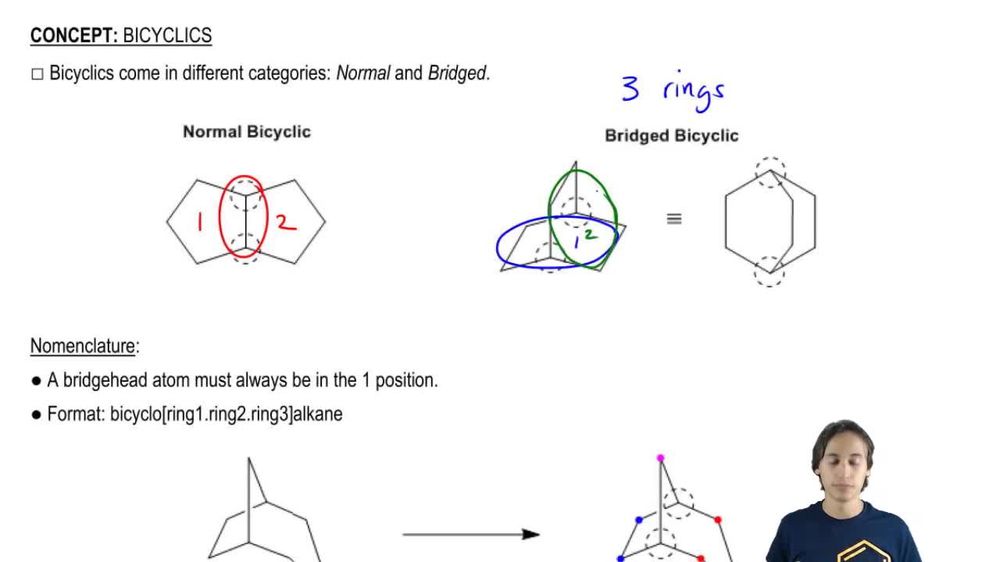
Bicyclic compounds consist of two interconnected rings and can exhibit unique chemical properties compared to their monocyclic counterparts. The synthesis of bicyclic structures often involves strategic bond formation and rearrangement, which can be achieved through various organic reactions. Recognizing the stereochemistry and potential isomerism in bicyclic systems is essential for successful synthesis.
Multistep synthesis refers to the process of constructing a complex molecule through a series of chemical reactions, each building upon the previous step. This approach allows chemists to introduce functional groups, create new bonds, and manipulate molecular structures systematically. Mastery of multistep synthesis is vital for organic chemists, as it enables the transformation of simple starting materials into intricate target compounds.