Using cyclohexane as one of your starting materials, show how you would synthesize the following compounds. (e)
Verified step by step guidance
1
Step 1: Begin with cyclohexane as the starting material. Cyclohexane is a saturated hydrocarbon with the molecular formula C6H12. To introduce a functional group, you need to activate one of the hydrogens on the ring.
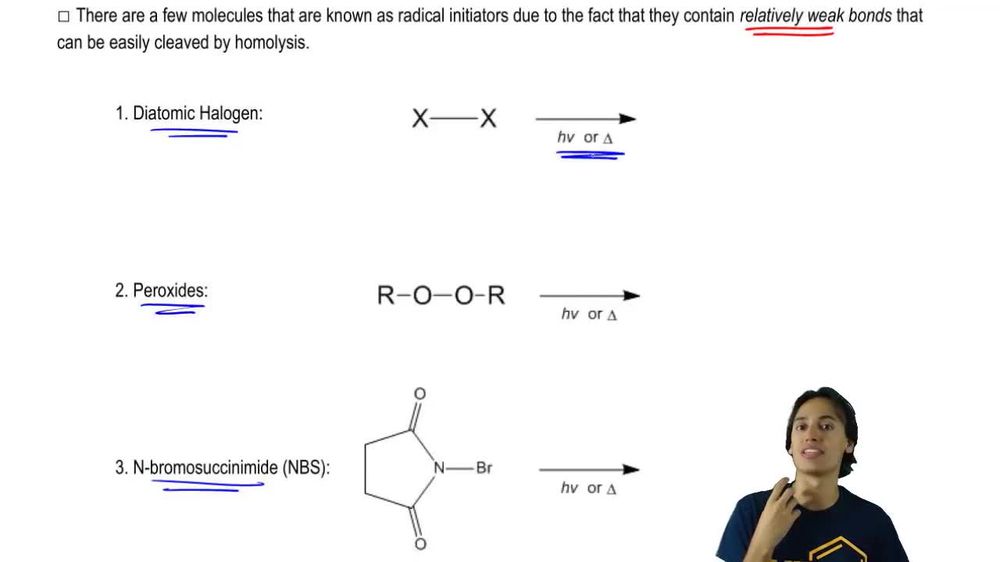
Step 2: Perform a free radical halogenation reaction using bromine (Br2) and light (hv) or heat. This will replace one hydrogen atom on the cyclohexane ring with a bromine atom, forming bromocyclohexane.
Step 3: Prepare a nucleophile for substitution. Use methoxide ion (CH3O⁻), which can be generated from sodium methoxide (NaOCH3) in methanol. Methoxide is a strong nucleophile and will readily participate in a substitution reaction.
Step 4: Perform an SN2 reaction between bromocyclohexane and methoxide ion. The bromine atom will be replaced by the methoxy group (-OCH3), resulting in the formation of methoxycyclohexane.
Step 5: Purify the product using standard organic chemistry techniques such as distillation or recrystallization to isolate methoxycyclohexane.
Verified video answer for a similar problem:
This video solution was recommended by our tutors as helpful for the problem above
Video duration:
5m
Play a video:
0 Comments
Key Concepts
Here are the essential concepts you must grasp in order to answer the question correctly.
Cyclohexane Structure and Reactivity
Cyclohexane is a six-membered carbon ring that is saturated, meaning it contains only single bonds. Its stable chair conformation minimizes steric strain, making it a common starting material in organic synthesis. Understanding its structure is crucial for predicting how it will react in various chemical transformations, including substitution and radical reactions.
Radical reactions involve species with unpaired electrons, known as radicals, which can initiate chain reactions. In the context of synthesizing compounds from cyclohexane, radical halogenation can introduce functional groups like methoxy (OCH3) through the abstraction of hydrogen atoms. Mastery of radical mechanisms is essential for designing effective synthetic pathways.
Functional group transformation refers to the process of converting one functional group into another, which is a key aspect of organic synthesis. In this case, converting cyclohexane into a methoxy-substituted cyclohexane involves introducing an ether group. Understanding the reactivity and compatibility of different functional groups is vital for successful synthesis.

 5:30 minutes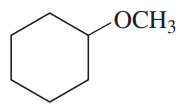
 Verified step by step guidance
 01:17
01:17