Ch.3 - Structure and Stereochemistry of Alkanes
Wade - Organic Chemistry 9th Edition
Wade9th EditionOrganic ChemistryISBN: 9780135213728Not the one you use?Change textbook
Chapter 3, Problem 40a,b

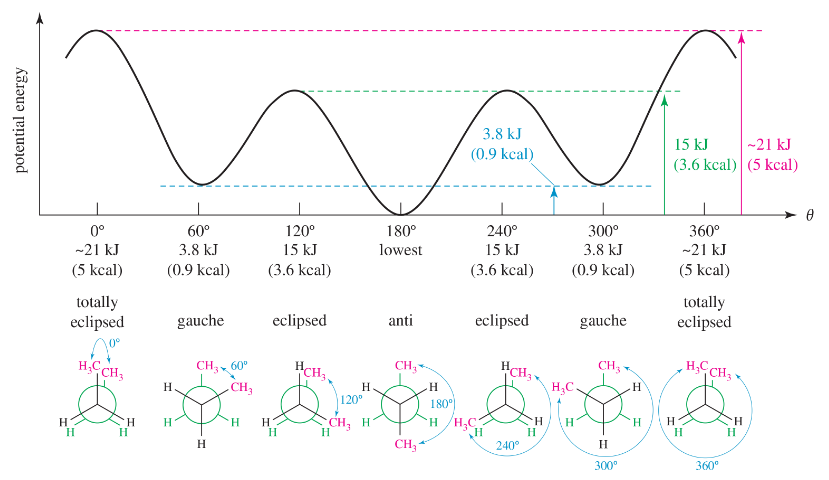
Construct a graph, similar to Figure 3-11, of the torsional energy of 3-methylpentane along the C2―C3 bond.
a. Place C2 in front, represented by three bonds coming together in a Y shape, and C3 in back, represented by a circle with three bonds pointing out from it.
b. Define the dihedral angle as the angle between the methyl group on the front carbon and the ethyl group on the back carbon.

Verified step by step guidance
1
Step 1: Begin by understanding the torsional energy graph provided in the image. The graph represents the potential energy changes as the dihedral angle (θ) between substituents on adjacent carbons changes. The peaks correspond to eclipsed conformations, while the valleys correspond to staggered conformations.
Step 2: For 3-methylpentane, focus on the C2-C3 bond. Place C2 in the front, represented by three bonds forming a Y shape, and C3 in the back, represented by a circle with three bonds pointing outward. This is the standard Newman projection setup.
Step 3: Define the dihedral angle as the angle between the methyl group on the front carbon (C2) and the ethyl group on the back carbon (C3). Rotate the back carbon (C3) relative to the front carbon (C2) to generate different conformations, such as eclipsed, gauche, and anti.
Step 4: Construct the torsional energy graph by plotting the potential energy against the dihedral angle (θ). Use the energy values and conformations from the image as a reference. For example, totally eclipsed conformations have the highest energy (~21 kJ), while anti conformations have the lowest energy (~0 kJ). Gauche and eclipsed conformations fall in between.
Step 5: Label the graph with the dihedral angles (0°, 60°, 120°, 180°, 240°, 300°, 360°) and corresponding conformations (totally eclipsed, gauche, eclipsed, anti, etc.). Ensure the energy values are consistent with the image provided, and include Newman projections for each conformation below the graph for clarity.

Verified video answer for a similar problem:

This video solution was recommended by our tutors as helpful for the problem above.
Video duration:
8m
Was this helpful?

Key Concepts

Here are the essential concepts you must grasp in order to answer the question correctly.

Torsional Strain

Torsional strain arises from the repulsion between electron clouds in eclipsed conformations of a molecule. In the case of 3-methylpentane, as the dihedral angle between substituents on adjacent carbons changes, the energy associated with these interactions varies. This strain is a key factor in determining the stability of different conformations, with staggered conformations being more stable than eclipsed ones.
Recommended video:
Guided course
02:00
What is torsional strain?

Dihedral Angle

The dihedral angle is the angle between two intersecting planes, specifically the angle formed by two bonds on adjacent atoms. In the context of 3-methylpentane, it is defined as the angle between the methyl group on C2 and the ethyl group on C3. This angle is crucial for understanding the conformational energy landscape of the molecule, as it influences torsional strain and overall stability.
Recommended video:
Guided course
02:46
What is angle strain?

Potential Energy Diagram

A potential energy diagram visually represents the energy changes associated with different conformations of a molecule as a function of the dihedral angle. For 3-methylpentane, the graph illustrates energy minima and maxima corresponding to staggered and eclipsed conformations, respectively. Understanding this diagram helps predict the most stable conformations and the energy barriers between them, which is essential for analyzing molecular behavior.
Recommended video:
Guided course
06:07
Introduction to free energy diagrams.