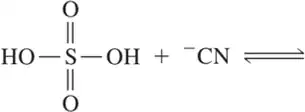
For the following acid–base pairs, (i) complete the reaction; (ii) identify the acid (A), base (B), conjugate acid (CA), and conjugate base (CB); (f)
Verified step by step guidance
1
Step 1: Write the general form of an acid-base reaction. In an acid-base reaction, the acid donates a proton (H⁺) to the base, forming the conjugate base of the acid and the conjugate acid of the base. Represent this as: Acid + Base → Conjugate Base + Conjugate Acid.
Step 2: Identify the reactants in the given acid-base pair. Determine which species acts as the acid (proton donor) and which acts as the base (proton acceptor). Use the Brønsted-Lowry definition of acids and bases for this step.
Step 3: Complete the reaction by transferring a proton (H⁺) from the acid to the base. Write the products formed: the conjugate base (the acid after losing a proton) and the conjugate acid (the base after gaining a proton).
Step 4: Label each species in the reaction. Identify the acid (A), base (B), conjugate acid (CA), and conjugate base (CB) based on their roles in the reaction. Remember: the acid and base are on the reactant side, while the conjugate acid and conjugate base are on the product side.
Step 5: Verify the reaction is balanced in terms of both mass and charge. Ensure that the number of atoms and the overall charge are the same on both sides of the equation.
Verified video answer for a similar problem:
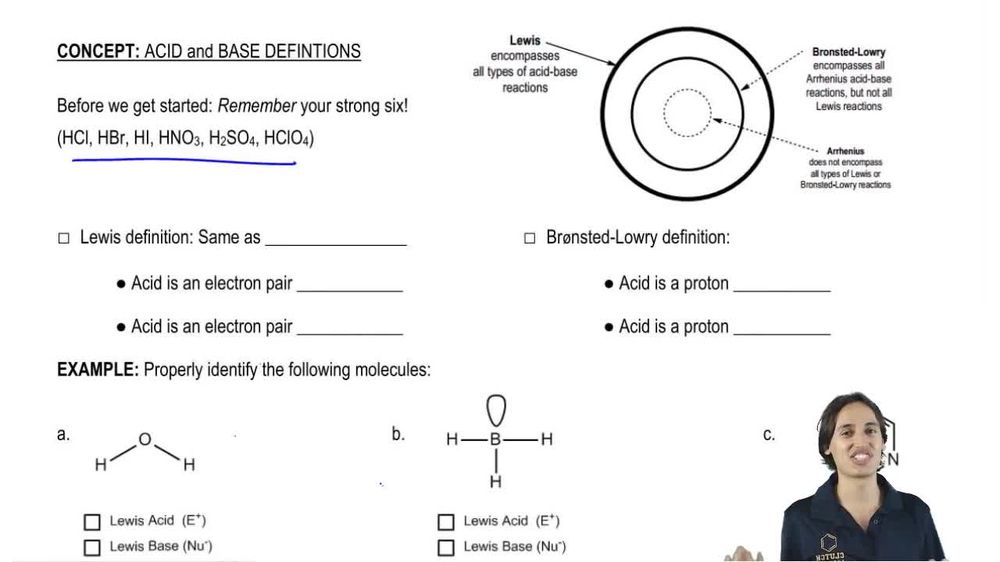
This video solution was recommended by our tutors as helpful for the problem above
Video duration:
4m
Play a video:
0 Comments
Key Concepts
Here are the essential concepts you must grasp in order to answer the question correctly.
Acid-Base Theory
Acid-base theory explains the behavior of acids and bases in chemical reactions. According to the Brønsted-Lowry theory, an acid is a proton donor, while a base is a proton acceptor. This framework helps in identifying the roles of different species in a reaction, allowing for the classification of substances as acids or bases based on their ability to donate or accept protons.
Conjugate acid-base pairs consist of two species that differ by the presence of a proton (H+). When an acid donates a proton, it forms its conjugate base, while the base that accepts the proton becomes its conjugate acid. Understanding these pairs is crucial for predicting the direction of acid-base reactions and the relative strength of acids and bases.
Completing a reaction involves identifying the products formed when an acid reacts with a base. This requires knowledge of the specific reactants and their properties, as well as the ability to apply acid-base theory to determine the resulting conjugate acids and bases. Accurately completing the reaction is essential for understanding the dynamics of acid-base interactions.