Sodium amide (NaNH2) dissociates to give a sodium cation (Na+) and amide ion (NH2-) a very strong base. In the following three equations, identify which definition of base is being exemplified. (c)
Verified step by step guidance
1
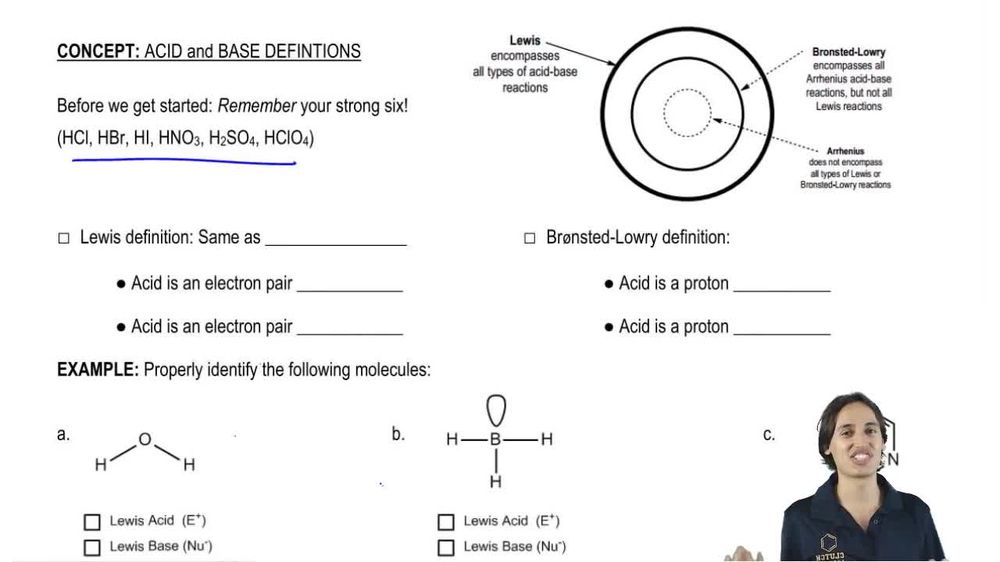
Step 1: Recall the three main definitions of a base in chemistry: Arrhenius, Bronsted-Lowry, and Lewis. Each definition describes a base differently based on its behavior in a chemical reaction.
Step 2: Analyze the dissociation of sodium amide (NaNH₂) into sodium cation (Na⁺) and amide ion (NH⁻₂). The amide ion (NH⁻₂) is a very strong base. Consider how this ion interacts in the context of the three definitions.
Step 3: For the Arrhenius definition, a base is a substance that increases the concentration of hydroxide ions (OH⁻) in aqueous solution. Sodium amide does not directly produce OH⁻ ions, so this definition may not apply here.
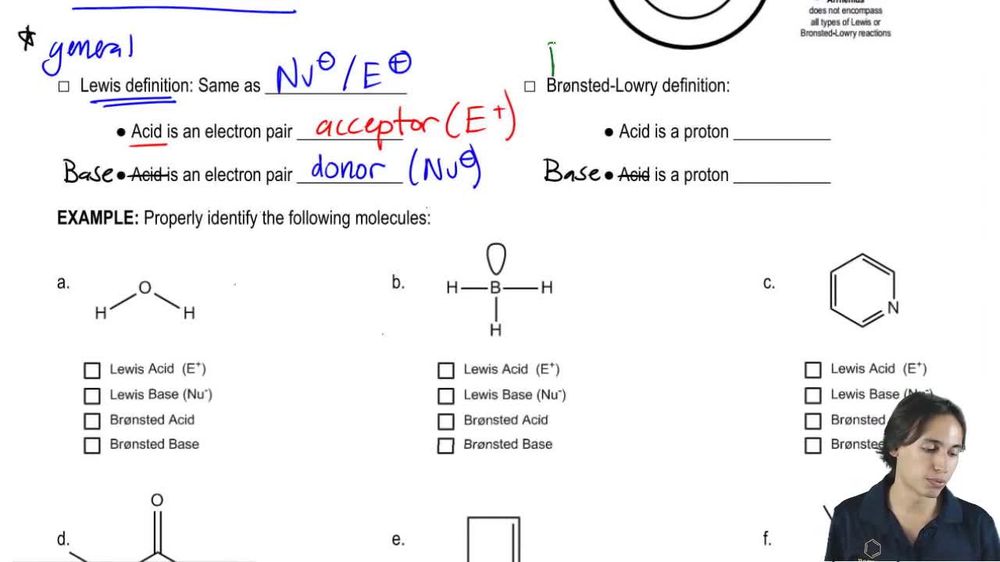
Step 4: For the Bronsted-Lowry definition, a base is a proton acceptor. The amide ion (NH⁻₂) can accept a proton (H⁺) to form ammonia (NH₃), exemplifying the Bronsted-Lowry definition of a base.
Step 5: For the Lewis definition, a base is an electron pair donor. The amide ion (NH⁻₂) has a lone pair of electrons that can be donated to an electron-deficient species, demonstrating the Lewis definition of a base. Evaluate the equations provided to identify which definition is being exemplified in each case.
Verified video answer for a similar problem:
This video solution was recommended by our tutors as helpful for the problem above
Video duration:
4m
Play a video:
0 Comments
Key Concepts
Here are the essential concepts you must grasp in order to answer the question correctly.
Brønsted-Lowry Base
A Brønsted-Lowry base is defined as a substance that can accept protons (H⁺ ions) in a chemical reaction. In the context of sodium amide, the amide ion (NH₂⁻) acts as a Brønsted-Lowry base by accepting protons from acids, thereby facilitating various acid-base reactions.
A Lewis base is defined as a substance that can donate an electron pair to form a covalent bond. The amide ion (NH₂⁻) can also be considered a Lewis base because it has a lone pair of electrons that can be donated to electrophiles, participating in nucleophilic reactions.
A strong base is a substance that completely dissociates in solution to produce hydroxide ions (OH⁻) or other strong anions. Sodium amide is classified as a strong base because it dissociates completely in water to yield the highly reactive amide ion, which can deprotonate weak acids effectively.