Sodium amide (NaNH2) dissociates to give a sodium cation (Na+) and amide ion (NH2-) a very strong base. In the following three equations, identify which definition of base is being exemplified. (a)
Verified step by step guidance
1
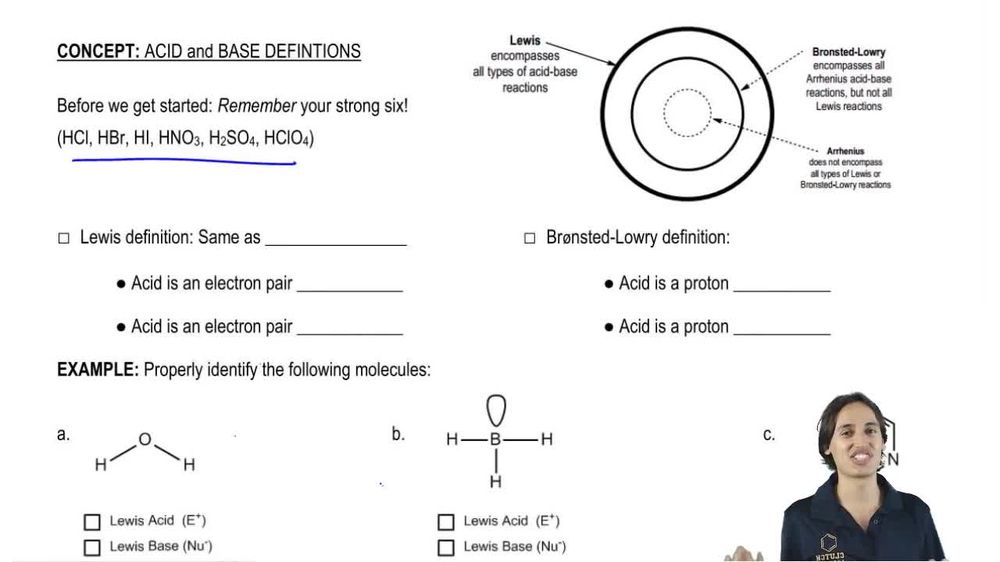
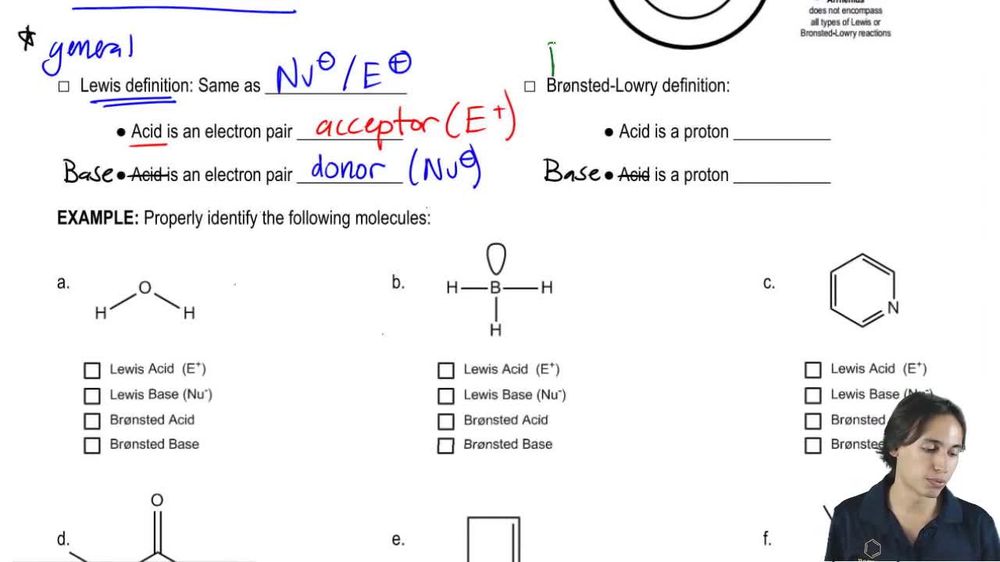
Step 1: Recall the three main definitions of a base in chemistry: (1) Arrhenius base - a substance that increases the concentration of OH⁻ ions in aqueous solution, (2) Brønsted-Lowry base - a substance that accepts a proton (H⁺), and (3) Lewis base - a substance that donates a pair of electrons.
Step 2: Analyze the dissociation of sodium amide (NaNH₂). When NaNH₂ dissociates, it forms Na⁺ and NH₂⁻. The NH₂⁻ ion is a strong base. Determine which definition of a base applies to this behavior.
Step 3: For each equation provided, examine the role of NH₂⁻. If NH₂⁻ is accepting a proton (H⁺), it is acting as a Brønsted-Lowry base. If NH₂⁻ is donating a pair of electrons to form a bond, it is acting as a Lewis base.
Step 4: For equation (a), identify whether NH₂⁻ is increasing the concentration of OH⁻ ions in solution (Arrhenius base), accepting a proton (Brønsted-Lowry base), or donating an electron pair (Lewis base).
Step 5: Match the behavior of NH₂⁻ in equation (a) to the appropriate base definition and repeat this process for the other equations to identify the base definition being exemplified in each case.
Verified video answer for a similar problem:
This video solution was recommended by our tutors as helpful for the problem above
Video duration:
3m
Play a video:
0 Comments
Key Concepts
Here are the essential concepts you must grasp in order to answer the question correctly.
Brønsted-Lowry Base
A Brønsted-Lowry base is defined as a substance that can accept protons (H⁺ ions) in a chemical reaction. In the context of sodium amide, the amide ion (NH₂⁻) acts as a Brønsted-Lowry base by accepting protons from acids, thereby facilitating various acid-base reactions.
A Lewis base is defined as an electron pair donor in a chemical reaction. Sodium amide's amide ion can donate a pair of electrons to form a bond with a Lewis acid, demonstrating its behavior as a Lewis base. This concept broadens the understanding of basicity beyond proton transfer.
A strong base is a substance that completely dissociates in solution to produce hydroxide ions (OH⁻) or other strong basic ions. Sodium amide is classified as a strong base because it dissociates fully in solution, resulting in the formation of the highly reactive amide ion, which can readily deprotonate weak acids.