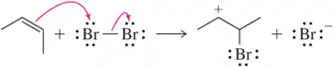
Identify the Lewis acid and the Lewis base in each of the following reactions. (c)
Verified step by step guidance
1
Step 1: Recall the definitions of Lewis acid and Lewis base. A Lewis acid is a species that can accept a pair of electrons, while a Lewis base is a species that can donate a pair of electrons.
Step 2: Examine the reaction provided in part (c). Identify the species involved in the reaction and determine which one is donating electrons and which one is accepting electrons.
Step 3: Look for electron-rich species (Lewis base) and electron-deficient species (Lewis acid). For example, a molecule with a lone pair of electrons or a negative charge is likely to act as a Lewis base, while a molecule with an incomplete octet or a positive charge is likely to act as a Lewis acid.
Step 4: Represent the interaction using chemical structures or equations. Use arrows to show the flow of electrons from the Lewis base to the Lewis acid.
Step 5: Confirm your identification by ensuring that the Lewis base donates electrons to the Lewis acid, forming a new bond or stabilizing the electron-deficient species.
Verified video answer for a similar problem:
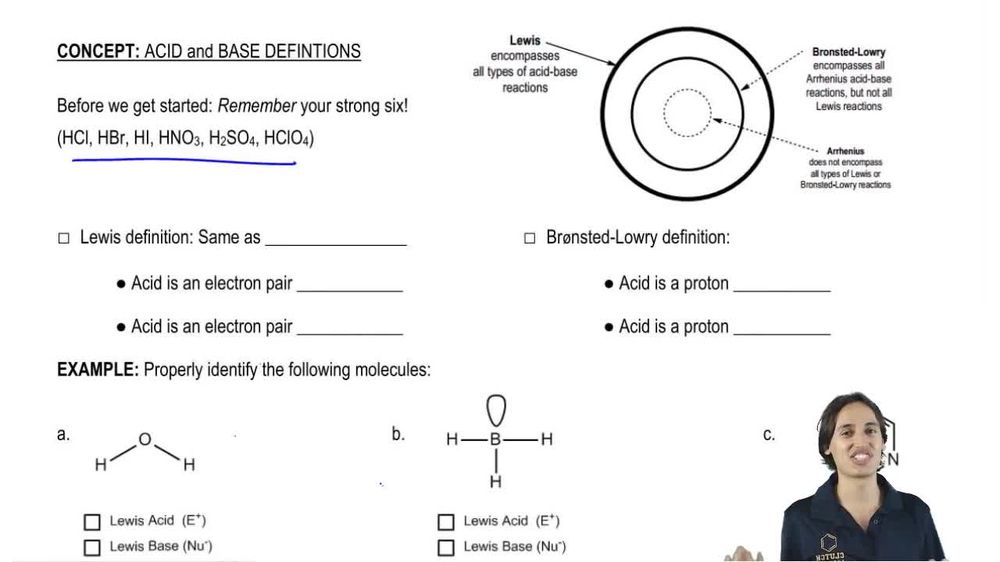
This video solution was recommended by our tutors as helpful for the problem above
Video duration:
2m
Play a video:
0 Comments
Key Concepts
Here are the essential concepts you must grasp in order to answer the question correctly.
Lewis Acids and Bases
Lewis acids are substances that can accept an electron pair, while Lewis bases are those that can donate an electron pair. This definition expands the traditional Brønsted-Lowry concept of acids and bases, allowing for a broader range of chemical reactions to be analyzed. Understanding these roles is crucial for identifying the reactants in a given reaction.
In Lewis acid-base theory, the interaction between an acid and a base involves the transfer of an electron pair. The Lewis base donates its electron pair to the Lewis acid, which accepts it. This interaction forms a coordinate covalent bond, which is fundamental in many chemical reactions, including complex formation and catalysis.
Analyzing the reaction mechanism helps in understanding how reactants transform into products, including the roles of Lewis acids and bases. Mechanisms often involve steps where electron pairs are transferred, leading to the formation of intermediates and products. Familiarity with these mechanisms is essential for predicting the outcomes of reactions and identifying the Lewis acid and base.