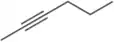
For the alkynes shows here, show the product(s) expected to form when treated under the following conditions: (viii) Cl2 (1 equiv.). If you expect two products, show both. (c)
Verified step by step guidance
1
Identify the alkyne structure provided in the problem. Alkynes are hydrocarbons containing a carbon-carbon triple bond (C≡C). Determine if the alkyne is terminal (triple bond at the end of the chain) or internal (triple bond within the chain).
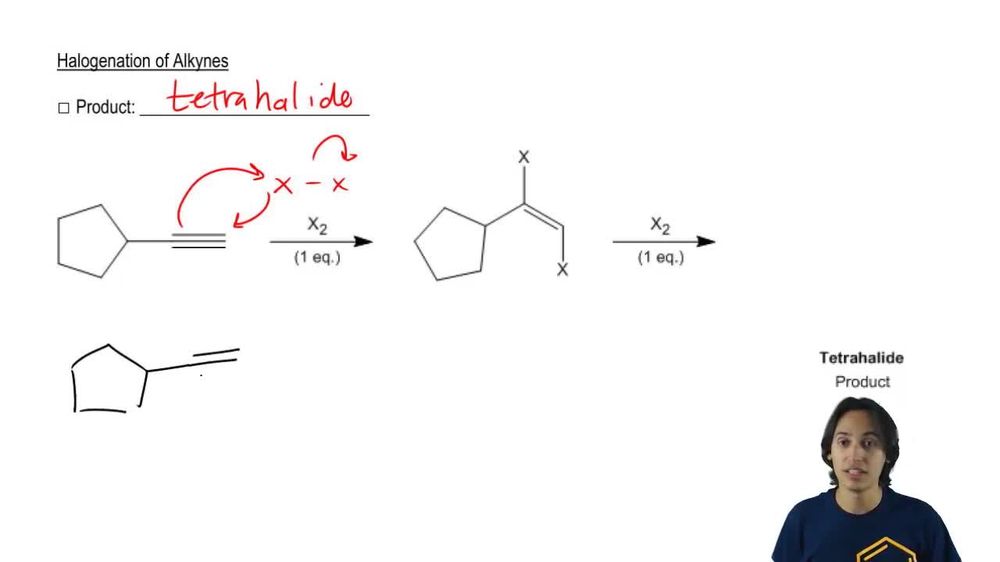
Understand the reagent and reaction conditions: Cl₂ (1 equiv.) indicates that one equivalent of chlorine (Cl₂) will react with the alkyne. This is a halogenation reaction, where the alkyne reacts with halogens to form dihaloalkenes.
Recognize the mechanism: The reaction proceeds via an anti-addition mechanism. The Cl₂ molecule adds across the triple bond, breaking one π-bond of the alkyne and forming a double bond (C=C). The two chlorine atoms attach to the carbons of the former triple bond in a trans (anti) configuration.
Determine the stereochemistry and regioselectivity: Since the reaction is anti-addition, the two chlorine atoms will be added to opposite sides of the double bond. If the alkyne is symmetrical, only one product will form. If the alkyne is asymmetrical, two stereoisomers (E and Z) may form.
Draw the product(s): For a symmetrical alkyne, draw the single dihaloalkene product with the chlorine atoms in a trans configuration. For an asymmetrical alkyne, draw both possible stereoisomers (E and Z) of the dihaloalkene, showing the placement of the chlorine atoms and the double bond.
Verified video answer for a similar problem:
This video solution was recommended by our tutors as helpful for the problem above
Video duration:
4m
Play a video:
0 Comments
Key Concepts
Here are the essential concepts you must grasp in order to answer the question correctly.
Alkynes
Alkynes are hydrocarbons that contain at least one carbon-carbon triple bond. They are unsaturated compounds and are generally more reactive than alkenes and alkanes due to the presence of the triple bond. This reactivity allows them to undergo various addition reactions, including halogenation, where halogens like Cl₂ can add across the triple bond.
Halogenation is a reaction where halogens, such as chlorine (Cl₂), react with unsaturated hydrocarbons. In the case of alkynes, the addition of Cl₂ can lead to the formation of dihaloalkenes or even saturated compounds, depending on the conditions. When one equivalent of Cl₂ is added to an alkyne, it typically results in the formation of a vinyl halide and a potential further reaction product.
Regioselectivity refers to the preference of a chemical reaction to yield one structural isomer over others when multiple products are possible. In the halogenation of alkynes, the position where the halogen adds can lead to different products, and understanding the regioselectivity helps predict which isomer will be favored. This concept is crucial for determining the expected products when treating alkynes with halogens.