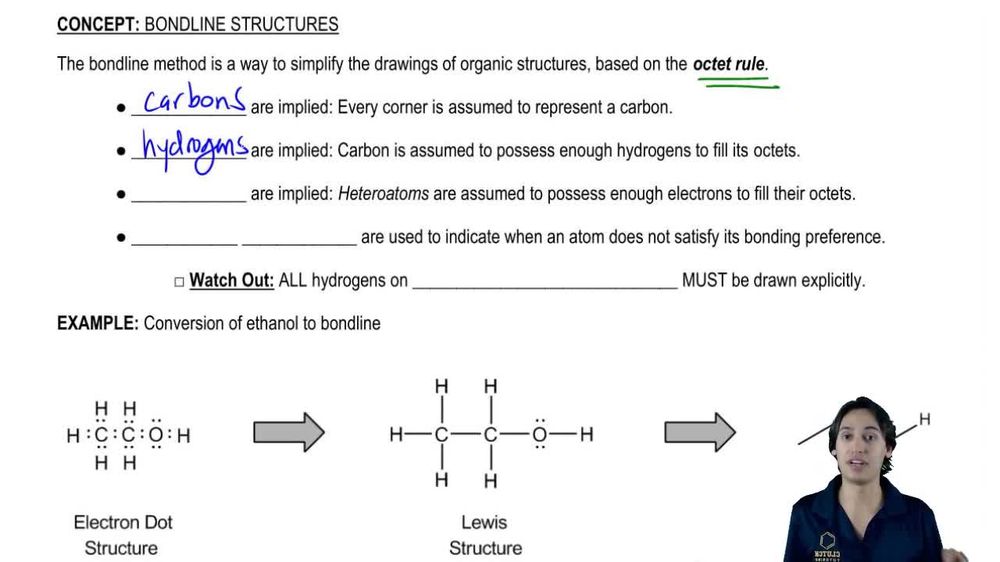
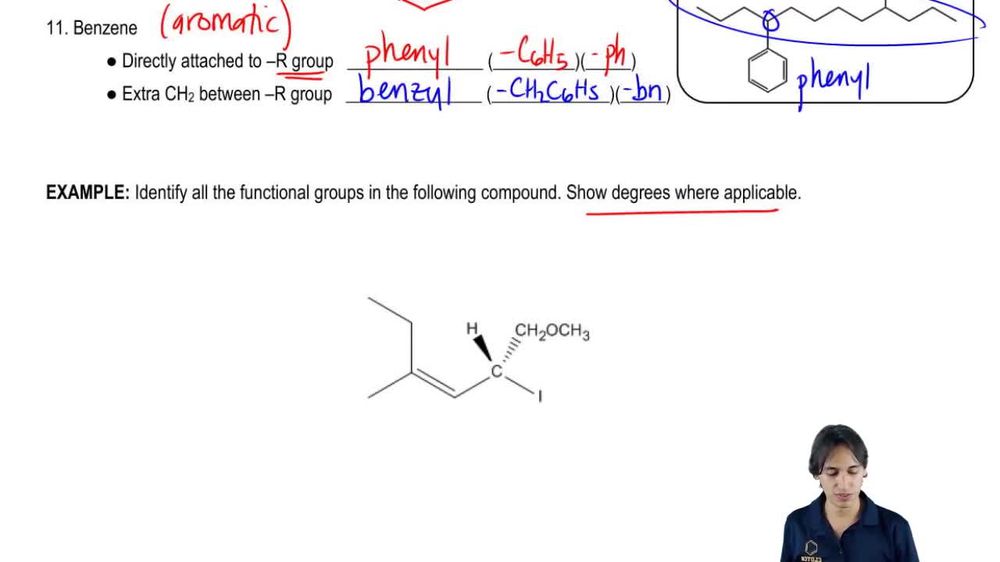
Draw the condensed and skeletal structures for each of the following: d. sec-butylisobutylacetylene
Verified step by step guidance
1
Step 1: Break down the name 'sec-butylisobutylacetylene' into its components. The main chain is 'acetylene,' which refers to a triple bond between two carbon atoms (C≡C). The substituents are 'sec-butyl' and 'isobutyl,' which are attached to the main chain.
Step 2: Understand the structure of the substituents. The 'sec-butyl' group is a four-carbon chain where the second carbon is connected to the main chain. The 'isobutyl' group is a four-carbon chain with a branching methyl group on the second carbon.
Step 3: Determine the connectivity. Attach the 'sec-butyl' group to one carbon of the acetylene (C≡C) and the 'isobutyl' group to the other carbon of the acetylene. This ensures both substituents are directly bonded to the triple-bonded carbons.
Step 4: Draw the skeletal structure. Represent the acetylene as a triple bond (C≡C) and use lines to represent the carbon chains of the 'sec-butyl' and 'isobutyl' groups. Ensure the branching is correctly depicted for both substituents.
Step 5: Draw the condensed structure. Write the acetylene as 'C≡C' and represent the substituents in their condensed forms. For example, 'sec-butyl' can be written as '(CH3)CHCH2CH3' and 'isobutyl' as '(CH3)2CHCH2'. Combine these with the acetylene to form the full condensed structure.
Verified video answer for a similar problem:
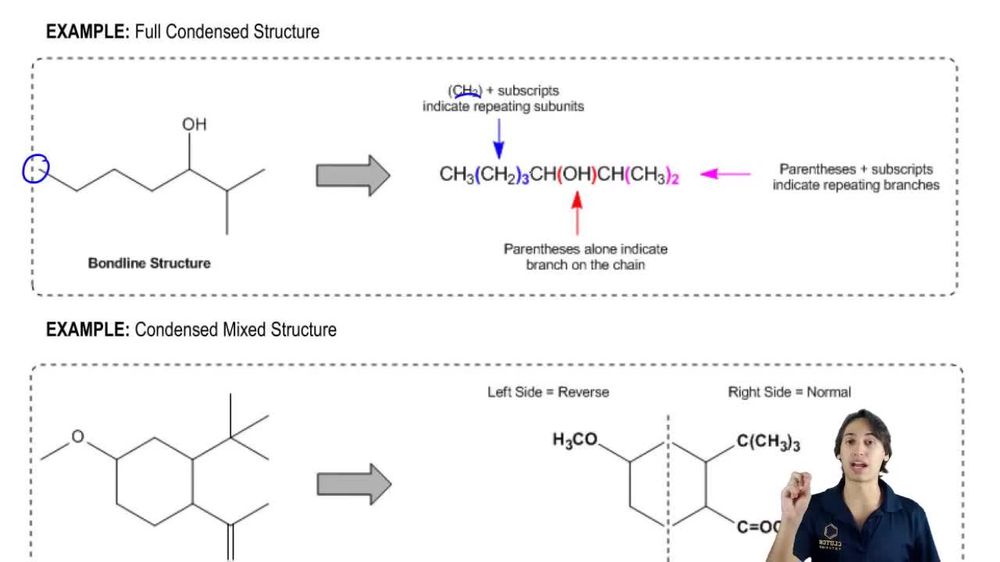
This video solution was recommended by our tutors as helpful for the problem above
Video duration:
8m
Play a video:
0 Comments
Key Concepts
Here are the essential concepts you must grasp in order to answer the question correctly.
Condensed Structures
Condensed structures are a simplified way of representing organic molecules where the connectivity of atoms is shown without depicting all the bonds explicitly. In these structures, groups of atoms are often grouped together, and hydrogen atoms attached to carbons are usually omitted for clarity. This format helps in quickly visualizing the molecular structure and understanding the arrangement of functional groups.
Skeletal structures, also known as line-angle structures, are a shorthand representation of organic molecules where carbon atoms are represented by vertices and lines represent bonds. Hydrogen atoms are typically not shown, as they are implied based on the tetravalency of carbon. This method allows chemists to easily visualize complex molecules and their connectivity without cluttering the diagram with all atoms.
Alkynes are hydrocarbons that contain at least one carbon-carbon triple bond, characterized by the general formula CnH2n-2. The presence of this triple bond significantly influences the chemical properties and reactivity of the molecule. In the case of sec-butylisobutylacetylene, understanding the alkyne structure is crucial for accurately drawing its condensed and skeletal forms, as it dictates the overall geometry and bonding of the compound.