
In Solved Problem 22-9, the target molecule was synthesized using a Michael addition to form the bond that is β,γ to the upper carbonyl group. Another approach is to use a Michael addition to form the bond that is β,γ to the other (lower) carbonyl group. Show how you would accomplish this alternative synthesis.
Ch. 22 - Condensations and Alpha Substitutions of Carbonyl Compounds
All textbooks
Wade 9th Edition
Ch. 22 - Condensations and Alpha Substitutions of Carbonyl Compounds
Problem 55a
Wade 9th Edition
Ch. 22 - Condensations and Alpha Substitutions of Carbonyl Compounds
Problem 55aChapter 22, Problem 55a
Propose a mechanism for the conjugate addition of a nucleophile (Nuc:–) to acrylonitrile (H2C=CHCN). Use resonance forms to show how the cyano activate the double bond toward conjugate addition.
Verified step by step guidance1
Step 1: Begin by identifying the structure of acrylonitrile (H₂C=CHCN). Acrylonitrile contains a double bond (C=C) conjugated with a cyano group (-CN). The cyano group is an electron-withdrawing group, which stabilizes the intermediate formed during the conjugate addition reaction.
Step 2: Use resonance structures to show how the cyano group activates the double bond. Draw the resonance forms of acrylonitrile, where the electron density from the π-bond of the double bond shifts toward the cyano group. This creates a partial positive charge on the β-carbon (the carbon adjacent to the cyano group) and a partial negative charge on the cyano group.
Step 3: Introduce the nucleophile (Nuc:-). The nucleophile attacks the β-carbon of the double bond in a conjugate addition reaction. This occurs because the β-carbon is electrophilic due to the electron-withdrawing effect of the cyano group.
Step 4: Show the formation of the intermediate. After the nucleophile attacks the β-carbon, the π-electrons of the double bond shift to the α-carbon (the carbon directly bonded to the cyano group), creating a carbanion intermediate. Represent this intermediate with resonance forms to show how the negative charge is delocalized and stabilized by the cyano group.
Step 5: Conclude the mechanism by protonating the carbanion intermediate (if necessary) to form the final product. The nucleophile is now covalently bonded to the β-carbon, and the cyano group remains attached to the α-carbon, completing the conjugate addition reaction.

Verified video answer for a similar problem:
This video solution was recommended by our tutors as helpful for the problem above.
Video duration:
3mWas this helpful?
Key Concepts
Here are the essential concepts you must grasp in order to answer the question correctly.
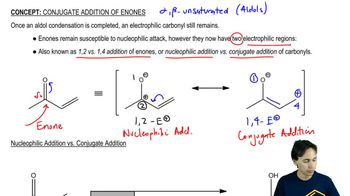
Conjugate Addition
Conjugate addition refers to the nucleophilic attack on an α,β-unsaturated carbonyl compound, where the nucleophile adds to the β-carbon instead of the carbonyl carbon. This process is significant in organic synthesis as it allows for the formation of new carbon-carbon bonds. The stability of the resulting enolate or resonance-stabilized intermediate is a key factor in driving this reaction.
Recommended video:
Guided course
1,2 vs 1,4 Addition
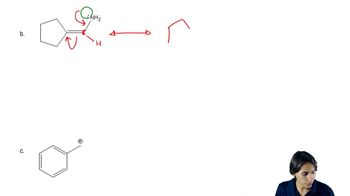
Resonance and Electron Delocalization
Resonance is a concept in organic chemistry that describes the delocalization of electrons within a molecule, allowing for multiple valid Lewis structures. In the case of acrylonitrile, the cyano group (-CN) can stabilize the double bond through resonance, making the β-carbon more electrophilic and susceptible to nucleophilic attack. This delocalization enhances the reactivity of the double bond in conjugate addition reactions.
Recommended video:
Guided course
Drawing Resonance Structures
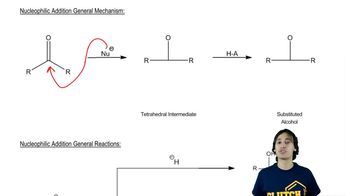
Nucleophiles
Nucleophiles are species that donate an electron pair to form a chemical bond in a reaction. They are typically negatively charged or neutral molecules with lone pairs of electrons. In the context of the conjugate addition to acrylonitrile, the nucleophile (Nuc:-) attacks the electrophilic β-carbon, facilitated by the resonance effects of the cyano group, leading to the formation of a new bond.
Recommended video:
Guided course
Nucleophilic Addition
Related Practice
Textbook Question
998
views
Textbook Question
Show how an acetoacetic ester synthesis might be used to form a δ-diketone such as heptane-2,6-dione.
1099
views
Textbook Question
Propose a mechanism for the conjugate addition of a nucleophile (Nuc:–) to acrylonitrile (H2C=CHCN) and to nitroethylene. Use resonance forms to show how the cyano and nitro groups activate the double bond toward conjugate addition.
735
views
Textbook Question
Show how cyclohexanone might be converted to the following δ-diketone (Hint: Stork).
185
views
Textbook Question
Show how the following products might be synthesized from suitable Michael donors and acceptors.
(a)
1323
views
Textbook Question
Show how the following products might be synthesized from suitable Michael donors and acceptors.
(b)
1189
views