Ch.10 - Structure and Synthesis of Alcohols
Wade - Organic Chemistry 9th Edition
Wade9th EditionOrganic ChemistryISBN: 9780135213728Not the one you use?Change textbook
Chapter 10, Problem 25c

Predict the products you would expect from the reaction of LiALH4 followed by hydrolysis with the following compounds. You may assume that these reactions take place in methanol as the solvent.
(c) Ph-COOH

Verified step by step guidance
1
Identify the functional group in the given compound. In this case, Ph-COOH is a benzoic acid, which contains a carboxylic acid functional group (-COOH) attached to a benzene ring (Ph).
Understand the role of LiAlH4 (lithium aluminum hydride). LiAlH4 is a strong reducing agent that reduces carboxylic acids (-COOH) to primary alcohols (-CH2OH).
Write the reaction mechanism. LiAlH4 donates hydride ions (H⁻) to the carbonyl carbon of the carboxylic acid group, breaking the C=O bond and forming an intermediate alkoxide ion.
Perform the hydrolysis step. After the reduction by LiAlH4, the reaction is followed by hydrolysis (addition of water), which protonates the alkoxide ion to form the final alcohol product.
Predict the product. The carboxylic acid group (-COOH) in Ph-COOH will be reduced to a primary alcohol (-CH2OH), resulting in benzyl alcohol (Ph-CH2OH) as the final product.

Verified video answer for a similar problem:

This video solution was recommended by our tutors as helpful for the problem above.
Video duration:
2m
Was this helpful?

Key Concepts

Here are the essential concepts you must grasp in order to answer the question correctly.

Lithium Aluminum Hydride (LiAlH4) as a Reducing Agent

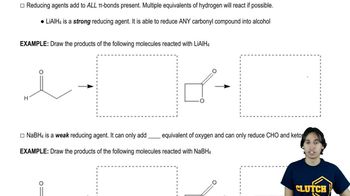
LiAlH4 is a powerful reducing agent commonly used in organic chemistry to reduce carbonyl compounds, carboxylic acids, and esters to their corresponding alcohols. It donates hydride ions (H-) to the electrophilic carbon of the carbonyl group, facilitating the reduction process. Understanding its reactivity is crucial for predicting the products of reactions involving carbonyl-containing compounds.
Recommended video:
Guided course
09:28
Reducing Agents

Hydrolysis of Alkoxides

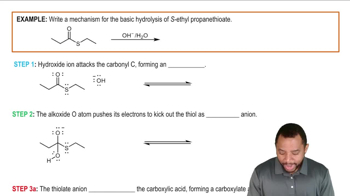
After LiAlH4 reduces a carboxylic acid, the resulting alkoxide intermediate can be hydrolyzed by adding water or an alcohol, such as methanol. This hydrolysis step converts the alkoxide into an alcohol, releasing the aluminum species as a byproduct. Recognizing this transformation is essential for determining the final products of the reaction sequence.
Recommended video:
3:09
Hydrolysis of Thioesters Example 2

Carboxylic Acid Structure and Reactivity

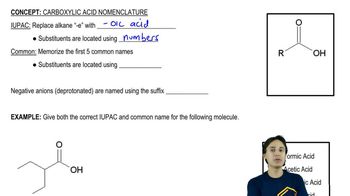
Carboxylic acids, characterized by the -COOH functional group, are polar compounds that can undergo various reactions, including reduction. Their reactivity is influenced by the presence of the carbonyl group, which is susceptible to nucleophilic attack. Understanding the structure and reactivity of carboxylic acids is vital for predicting the outcome of their reactions with reducing agents like LiAlH4.
Recommended video:
Guided course
04:20
Carboxylic Acids Nomenclature