Ch. 19 - Amines
Wade - Organic Chemistry 9th Edition
Wade9th EditionOrganic ChemistryISBN: 9780135213728Not the one you use?Change textbook
Chapter 19, Problem 38g

Predict the products of the following reactions:
(g) Chemical reaction showing a cyclic compound with an amine group reacting with sodium nitrite and hydrochloric acid.

Verified step by step guidance
1
Identify the type of reaction depicted in the image. Common types include substitution, addition, elimination, and rearrangement reactions. Understanding the reaction type will guide the prediction of products.
Examine the reactants and any reagents or catalysts present in the reaction. These can provide clues about the mechanism and the possible transformations that will occur.
Consider the stereochemistry and regiochemistry of the reactants. These factors can influence the orientation and position of the products formed.
Apply the reaction mechanism to predict the intermediate steps. This involves understanding how bonds are broken and formed during the reaction process.
Use the information from the previous steps to predict the final products, ensuring that all atoms are accounted for and that the products are stable according to organic chemistry principles.

Verified video answer for a similar problem:

This video solution was recommended by our tutors as helpful for the problem above.
Video duration:
7m
Was this helpful?

Key Concepts

Here are the essential concepts you must grasp in order to answer the question correctly.

Reaction Mechanisms

Understanding reaction mechanisms is crucial in organic chemistry as they describe the step-by-step process by which reactants transform into products. This includes identifying intermediates, transition states, and the movement of electrons. Familiarity with mechanisms helps predict the outcome of reactions and the stability of products formed.
Recommended video:
Guided course
02:16
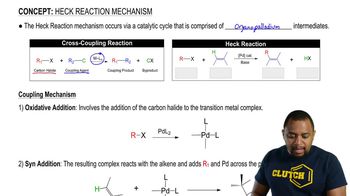
Heck Reaction Mechanism

Functional Groups

Functional groups are specific groups of atoms within molecules that are responsible for the characteristic chemical reactions of those molecules. Recognizing functional groups allows chemists to predict how different compounds will react under various conditions. This knowledge is essential for determining the products of organic reactions.
Recommended video:
Guided course
02:36
Identifying Functional Groups

Stereochemistry

Stereochemistry involves the study of the spatial arrangement of atoms in molecules and how this affects their chemical behavior. It is important for predicting the products of reactions, especially in cases where chirality or geometric isomerism is involved. Understanding stereochemical principles helps in anticipating the specific isomers that may be produced in a reaction.
Recommended video:
1:38
Polymer Stereochemistry Concept 1