
Use your results from Problem 3-27 to complete the following table. Each entry shows the positions of two groups arranged as shown. For example, two groups that are trans on adjacent carbons (trans-1,2) must be both equatorial (e,e) or both axial (a,a).
Ch.3 - Structure and Stereochemistry of Alkanes
Chapter 3, Problem 26c,d
Name the following compounds. Remember that two up bonds are cis; two down bonds are cis; one up bond and one down bond are trans.
(c) 
(d) 
Verified step by step guidance1
Step 1: Identify the cyclohexane ring in both compounds (c) and (d). Cyclohexane is a six-membered ring, which is the base structure for these compounds.
Step 2: Determine the substituents attached to the cyclohexane ring. In compound (c), there are two methyl groups (CH₃) attached. In compound (d), there are also two methyl groups attached.
Step 3: Analyze the orientation of the substituents. In compound (c), both methyl groups are on the same side of the ring, indicating a cis configuration. In compound (d), the methyl groups are on opposite sides of the ring, indicating a trans configuration.
Step 4: Name the compounds based on the substituents and their orientation. For compound (c), the name will include 'cis' to indicate the configuration, and for compound (d), the name will include 'trans'.
Step 5: Combine the information to form the complete names. For compound (c), it will be 'cis-1,2-dimethylcyclohexane', and for compound (d), it will be 'trans-1,4-dimethylcyclohexane'.

Verified video answer for a similar problem:
This video solution was recommended by our tutors as helpful for the problem above.
Video duration:
3mWas this helpful?
Key Concepts
Here are the essential concepts you must grasp in order to answer the question correctly.
Cis-Trans Isomerism
Cis-trans isomerism is a type of stereoisomerism where the spatial arrangement of groups around a double bond or a ring structure differs. In cis isomers, similar groups are on the same side, while in trans isomers, they are on opposite sides. This concept is crucial for understanding the geometric configuration of organic compounds, which can significantly affect their physical and chemical properties.
Recommended video:
Guided course
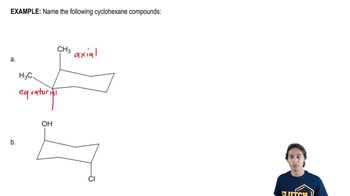
Is the following cyclohexane cis or trans?
Nomenclature of Organic Compounds
The nomenclature of organic compounds follows specific rules set by the International Union of Pure and Applied Chemistry (IUPAC). This includes identifying the longest carbon chain, naming substituents, and determining the correct prefixes and suffixes based on functional groups. Proper nomenclature is essential for clear communication in chemistry, allowing chemists to convey the structure and composition of compounds accurately.
Recommended video:
Guided course
Defining meso compounds.
Structural Representation of Molecules
Structural representation of molecules involves depicting the arrangement of atoms within a compound, including bonds and functional groups. Common representations include Lewis structures, condensed formulas, and skeletal formulas. Understanding these representations is vital for visualizing molecular geometry and predicting reactivity, which is particularly important when analyzing isomers and their properties.
Recommended video:
Guided course
Representations of L-Configuration
Related Practice
Textbook Question
910
views
Textbook Question
a. Draw both chair conformations of cis-1,4-dimethylcyclohexane, and determine which conformer is more stable.
b. Repeat for the trans isomer.
c. Predict which isomer (cis or trans) is more stable.
2522
views
Textbook Question
Name the following compounds. Remember that two up bonds are cis; two down bonds are cis; one up bond and one down bond are trans.
(e)
(f)
1155
views
Textbook Question
Draw the most stable conformation of
c. cis-1-tert-butyl-4-isopropylcyclohexane.
2912
views
Textbook Question
Draw the most stable conformation of
a. ethylcyclohexane.
3273
views
Textbook Question
Draw the most stable conformation of
b. 3-isopropyl-1,1-dimethylcyclohexane.
2601
views
