

Ch. 16 - Aromatic Compounds
Wade - Organic Chemistry 9th Edition
Wade9th EditionOrganic ChemistryISBN: 9780135213728Not the one you use?Change textbook
Chapter 16, Problem 36a(3)

The benzene ring alters the reactivity of a neighboring group in the benzylic position much as a double bond alters the reactivity of groups in the allylic position.

Benzylic cations, anions, and radicals are all more stable than simple alkyl intermediates.
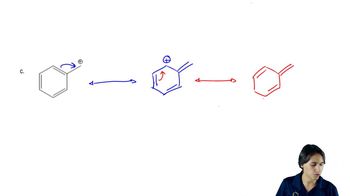
a. Use resonance forms to show the delocalization (over four carbon atoms) of the negative charge of the benzyl anion.

Verified step by step guidance
1
Step 1: Begin by identifying the benzyl anion structure. The benzyl anion consists of a benzene ring attached to a CH2 group with a negative charge on the carbon atom. This negative charge can be delocalized into the benzene ring through resonance.
Step 2: Draw the first resonance structure. The negative charge on the CH2 group can move to form a double bond between the CH2 carbon and one of the carbons in the benzene ring. This movement pushes the π-electrons in the benzene ring to the adjacent carbon, creating a negative charge on that carbon.
Step 3: Draw the second resonance structure. The negative charge on the benzene ring can further delocalize by moving the π-electrons to the next carbon in the ring, forming another double bond and shifting the negative charge to the next carbon atom.
Step 4: Draw the third resonance structure. Continue the delocalization process by moving the π-electrons to the next carbon in the benzene ring, forming another double bond and shifting the negative charge to the next carbon atom.
Step 5: Summarize the resonance forms. The negative charge of the benzyl anion is delocalized over four carbon atoms in the benzene ring, stabilizing the anion. This delocalization is a key feature of the benzyl group, making it more stable than a simple alkyl anion.

Verified video answer for a similar problem:

This video solution was recommended by our tutors as helpful for the problem above.
Video duration:
8m
Was this helpful?

Key Concepts

Here are the essential concepts you must grasp in order to answer the question correctly.

Resonance

Resonance is a concept in organic chemistry that describes the delocalization of electrons in molecules where the bonding cannot be expressed by a single Lewis structure. Instead, multiple structures, known as resonance forms, are used to represent the molecule's electron distribution. This delocalization stabilizes the molecule, as seen in the benzyl anion, where the negative charge can be spread over several atoms, enhancing stability.
Recommended video:
Guided course
03:04
Drawing Resonance Structures

Benzylic Position

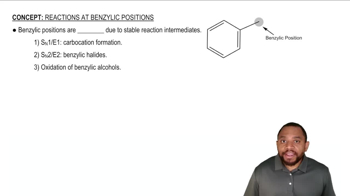
The benzylic position refers to the carbon atom directly attached to a benzene ring, specifically the carbon adjacent to the aromatic system. This position is significant because it exhibits unique reactivity patterns due to the influence of the benzene ring, which can stabilize intermediates like benzylic cations, anions, and radicals through resonance, making them more stable than their non-aromatic counterparts.
Recommended video:
1:01
Reactions at Benzylic Positions Concept 1

Stability of Intermediates

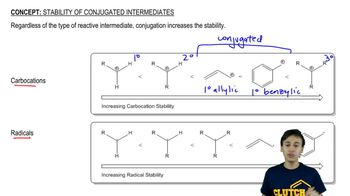
In organic chemistry, the stability of intermediates such as cations, anions, and radicals is crucial for understanding reaction mechanisms. Benzylic intermediates are particularly stable due to resonance stabilization, where the charge or radical can be delocalized over the aromatic ring. This increased stability affects the reactivity and pathways of chemical reactions involving benzylic compounds, making them more favorable compared to simple alkyl intermediates.
Recommended video:
Guided course
04:31
Stability of Conjugated Intermediates
Related Practice
Textbook Question

The benzene ring alters the reactivity of a neighboring group in the benzylic position much as a double bond alters the reactivity of groups in the allylic position.

Benzylic cations, anions, and radicals are all more stable than simple alkyl intermediates.

b. Toluene reacts with bromine in the presence of light to give benzyl bromide. Propose a mechanism for this reaction.

1777
views
Textbook Question

Some of the following compounds show aromatic properties, and others do not.

1. Predict which ones are likely to be aromatic, and explain why they are aromatic.

(n)

(o)

791
views
Textbook Question

The benzene ring alters the reactivity of a neighboring group in the benzylic position much as a double bond alters the reactivity of groups in the allylic position.

Benzylic cations, anions, and radicals are all more stable than simple alkyl intermediates.

a. Use resonance forms to show the delocalization (over four carbon atoms) of the unpaired electron of the benzyl radical.

1274
views
Textbook Question

The benzene ring alters the reactivity of a neighboring group in the benzylic position much as a double bond alters the reactivity of groups in the allylic position.


Benzylic cations, anions, and radicals are all more stable than simple alkyl intermediates.

a. Use resonance forms to show the delocalization (over four carbon atoms) of the positive charge of the benzyl cation.

1387
views
Textbook Question

Some of the following compounds show aromatic properties, and others do not.

1. Predict which ones are likely to be aromatic, and explain why they are aromatic.

2. Predict which nitrogen atoms are more basic than water and which are less basic.

(m)

465
views
Textbook Question

Some of the following compounds show aromatic properties, and others do not.

1. Predict which ones are likely to be aromatic, and explain why they are aromatic.

2. Predict which nitrogen atoms are more basic than water and which are less basic.

(f)

503
views