
Ch. 13 - Nuclear Magnetic Resonance Spectroscopy
Wade - Organic Chemistry 9th Edition
Wade9th EditionOrganic ChemistryISBN: 9780135213728Not the one you use?Change textbook
Chapter 13, Problem 1

In a 300-MHz spectrometer, the protons in iodomethane absorb at a position 650 Hz downfield from TMS.
(a) What is the chemical shift of these protons?
(b) What is the chemical shift of the iodomethane protons in a 60-MHz spectrometer?
(c) How many hertz downfield from TMS would they absorb at 60 MHz?

Verified step by step guidance
1
To solve part (a), recall that the chemical shift (δ) is calculated using the formula: δ = (ν_sample - ν_TMS) / ν_spectrometer, where ν_sample is the frequency of the sample, ν_TMS is the frequency of TMS, and ν_spectrometer is the operating frequency of the spectrometer. Here, ν_sample - ν_TMS is given as 650 Hz, and ν_spectrometer is 300 MHz. Convert 300 MHz to Hz (1 MHz = 10^6 Hz) and calculate δ in parts per million (ppm).
For part (b), note that the chemical shift (δ) is independent of the spectrometer frequency. The value of δ calculated in part (a) will remain the same for the 60-MHz spectrometer. This is because δ is a ratio and does not depend on the absolute spectrometer frequency.
To solve part (c), use the relationship between the chemical shift (δ) and the spectrometer frequency. The formula is: ν_sample - ν_TMS = δ × ν_spectrometer. Here, δ is the value calculated in part (a), and ν_spectrometer is 60 MHz (convert to Hz). Multiply δ by 60 MHz to find the number of hertz downfield from TMS at 60 MHz.
Ensure that all units are consistent throughout the calculations. Convert MHz to Hz where necessary and express the final answers in the appropriate units (ppm for chemical shift and Hz for frequency differences).
Review the concepts of chemical shift and its independence from spectrometer frequency to reinforce understanding. The chemical shift is a dimensionless quantity expressed in ppm, which standardizes NMR data across different spectrometers.

Verified video answer for a similar problem:

This video solution was recommended by our tutors as helpful for the problem above.
Video duration:
5m
Was this helpful?

Key Concepts

Here are the essential concepts you must grasp in order to answer the question correctly.

Chemical Shift

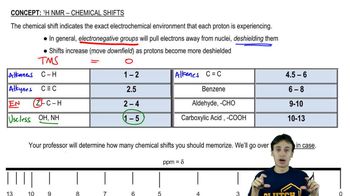
Chemical shift is a measure of the resonance frequency of a nucleus relative to a standard reference compound, typically tetramethylsilane (TMS) for protons in NMR spectroscopy. It is expressed in parts per million (ppm) and indicates the electronic environment surrounding the nucleus, which affects its magnetic field and thus its resonance frequency.
Recommended video:
Guided course
11:44
1H NMR Chemical Shifts

NMR Spectroscopy

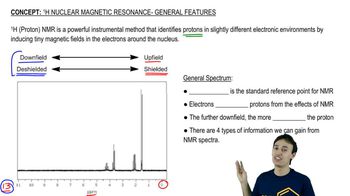
Nuclear Magnetic Resonance (NMR) spectroscopy is a technique used to observe the magnetic properties of atomic nuclei. In this method, a sample is placed in a strong magnetic field and exposed to radiofrequency radiation, causing nuclei to resonate at specific frequencies, which can be measured to provide information about the molecular structure and dynamics.
Recommended video:
Guided course
10:06
General NMR Features

Frequency and Magnetic Field Relationship

The frequency at which nuclei resonate in NMR is directly proportional to the strength of the magnetic field applied. This relationship means that when the magnetic field strength changes, the frequency of resonance also changes, affecting the observed chemical shift. Consequently, the same chemical environment will yield different resonance frequencies in different magnetic field strengths.
Recommended video:
Guided course
16:47
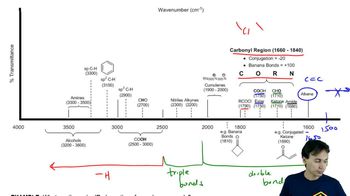
Common IR Frequencies