


Ch.1 - Structure and Bonding
Wade - Organic Chemistry 9th Edition
Wade9th EditionOrganic ChemistryISBN: 9780135213728Not the one you use?Change textbook
Chapter 1, Problem 25j,k

Give the relationship between the following pairs of structures. The possible relationships are:
same compound
constitutional isomers (structural isomers)
cis-trans isomers
not isomers (different molecular formula)


(j)
(k)

Verified step by step guidance
1
Step 1: Identify the molecular formula of each structure in the pair. This will help determine if the compounds are isomers (same molecular formula) or completely different compounds (different molecular formulas).
Step 2: Analyze the connectivity of atoms in each structure. If the molecular formulas are the same, check if the connectivity of atoms is identical (indicating they are the same compound) or different (indicating they are structural isomers).
Step 3: Examine the spatial arrangement of atoms. If the connectivity is the same, determine if the compounds differ in their three-dimensional arrangement. If they do, they may be stereoisomers (e.g., enantiomers or diastereomers).
Step 4: Check for any symmetry or plane of reflection in the structures. If the compounds are mirror images but not superimposable, they are enantiomers. If they are not mirror images but differ in spatial arrangement, they are diastereomers.
Step 5: Compare the structures to see if they are related by a simple rotation or conformational change. If so, they are conformers. If none of these relationships apply, the compounds are unrelated.

Verified video answer for a similar problem:

This video solution was recommended by our tutors as helpful for the problem above.
Video duration:
1m
Was this helpful?

Key Concepts

Here are the essential concepts you must grasp in order to answer the question correctly.

Structural Isomerism

Structural isomerism refers to compounds that have the same molecular formula but differ in the connectivity of their atoms. This can lead to different physical and chemical properties. Understanding structural isomers is crucial for analyzing relationships between different chemical structures, as it helps identify how variations in atom arrangement can affect reactivity and stability.
Recommended video:
Guided course
06:47
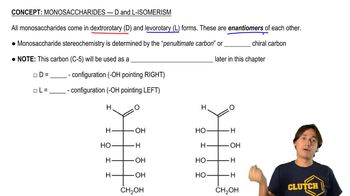
Monosaccharides - D and L Isomerism

Stereochemistry

Stereochemistry is the study of the spatial arrangement of atoms in molecules and how this affects their chemical behavior. It includes concepts such as chirality and geometric isomerism. Recognizing stereochemical relationships is essential for understanding how different configurations can lead to distinct biological activities and interactions in organic compounds.
Recommended video:
1:38
Polymer Stereochemistry Concept 1

Functional Groups

Functional groups are specific groups of atoms within molecules that are responsible for the characteristic chemical reactions of those molecules. They determine the properties and reactivity of organic compounds. Identifying functional groups in the given structures is vital for predicting their behavior and understanding the nature of their relationships.
Recommended video:
Guided course
02:36
Identifying Functional Groups