
Ch.10 - Structure and Synthesis of Alcohols
Wade - Organic Chemistry 9th Edition
Wade9th EditionOrganic ChemistryISBN: 9780135213728Not the one you use?Change textbook
Chapter 10, Problem 10b

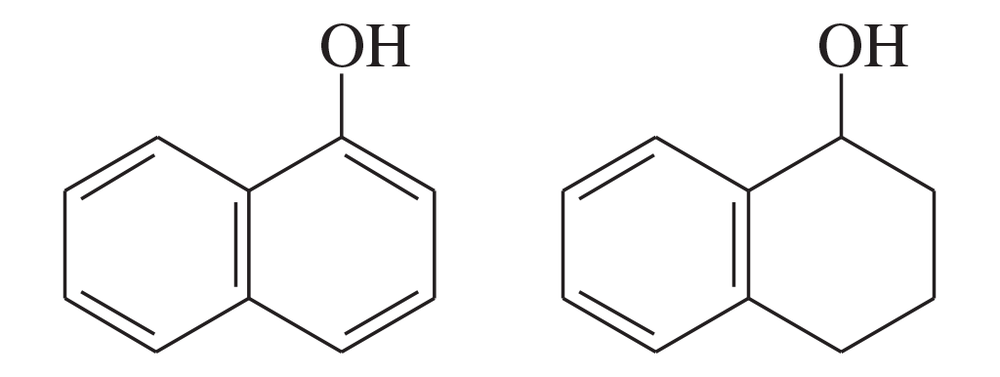
The following compounds are only slightly soluble in water, but one of them is very soluble in a dilute aqueous solution of sodium hydroxide. The other is still only slightly soluble.

(b) Show how this difference might be exploited to separate a mixture of these two compounds using a separatory funnel.

Verified step by step guidance
1
Step 1: Analyze the chemical structures of the two compounds. Compound A is cyclohexanol, a saturated alcohol, while Compound B is phenol, an aromatic alcohol. Phenol has a hydroxyl group attached to a benzene ring, which makes it more acidic compared to cyclohexanol.
Step 2: Understand the solubility behavior in the presence of sodium hydroxide. Phenol reacts with dilute aqueous sodium hydroxide to form phenoxide ion (C₆H₅O⁻), which is highly soluble in water due to its ionic nature. Cyclohexanol, being less acidic, does not react significantly with sodium hydroxide and remains only slightly soluble.
Step 3: Set up the separation process using a separatory funnel. Add the mixture of cyclohexanol and phenol to the funnel, along with dilute aqueous sodium hydroxide. The phenol will react with sodium hydroxide to form the soluble phenoxide ion, while cyclohexanol will remain in the organic layer.
Step 4: Shake the separatory funnel gently to allow the reaction and partitioning to occur. The aqueous layer will contain the phenoxide ion, and the organic layer will contain cyclohexanol.
Step 5: Separate the two layers. Drain the aqueous layer containing the phenoxide ion into one container and the organic layer containing cyclohexanol into another. To recover phenol, acidify the aqueous layer with a dilute acid (e.g., HCl) to precipitate phenol, which can then be extracted.

Verified video answer for a similar problem:

This video solution was recommended by our tutors as helpful for the problem above.
Video duration:
5m
Was this helpful?

Key Concepts

Here are the essential concepts you must grasp in order to answer the question correctly.

Solubility and Polarity

Solubility in water is largely determined by the polarity of a compound. Polar compounds tend to dissolve well in polar solvents like water, while non-polar compounds do not. In the context of phenolic compounds, the presence of hydroxyl (-OH) groups increases polarity, but the overall structure can influence solubility. Understanding the balance of polar and non-polar characteristics is crucial for predicting solubility behavior.
Recommended video:
Guided course
07:13
Functional Classification

Acid-Base Reactions

Phenolic compounds can act as weak acids due to the presence of the hydroxyl group, which can donate a proton (H+) in the presence of a strong base like sodium hydroxide (NaOH). This reaction can lead to the formation of phenoxide ions, which are more soluble in water. Recognizing how these compounds interact with bases is essential for understanding their solubility differences in aqueous solutions.
Recommended video:
Guided course
02:49
The Lewis definition of acids and bases.

Separation Techniques: Liquid-Liquid Extraction

Liquid-liquid extraction is a technique used to separate compounds based on their solubility in different solvents. In this case, a separatory funnel can be used to exploit the differing solubility of the phenolic compounds in sodium hydroxide. The compound that forms a soluble phenoxide ion can be extracted into the aqueous layer, while the other remains in the organic layer, allowing for effective separation.
Recommended video:
Guided course
05:41
Reason for Analytical Methods