Ch.9 - Alkynes
Wade - Organic Chemistry 9th Edition
Wade9th EditionOrganic ChemistryISBN: 9780135213728Not the one you use?Change textbook
Chapter 9, Problem 42a

Using any necessary inorganic reagents, show how you would convert acetylene and isobutyl bromide to
(a) meso-2,7-dimethyloctane-4,5-diol, (CH3)2CHCH2CH(OH)CH(OH)CH2CH(CH3)2.

Verified step by step guidance
1
Step 1: Deprotonate acetylene (C₂H₂) using a strong base such as sodium amide (NaNH₂) to generate the acetylide ion (C≡C⁻). This ion is a strong nucleophile and will be used in the next step.
Step 2: Perform an alkylation reaction by reacting the acetylide ion with isobutyl bromide ((CH₃)₂CHCH₂Br). This will result in the formation of 2-methyl-1-butyne ((CH₃)₂CHCH₂C≡CH).
Step 3: Perform a second alkylation reaction. Deprotonate the terminal alkyne in 2-methyl-1-butyne using NaNH₂ to form another acetylide ion. Then react this ion with another equivalent of isobutyl bromide to form 2,7-dimethyloct-3-yne ((CH₃)₂CHCH₂C≡CCH₂CH(CH₃)₂).
Step 4: Reduce the triple bond in 2,7-dimethyloct-3-yne to a cis-alkene using Lindlar's catalyst. This will yield cis-2,7-dimethyloct-3-ene ((CH₃)₂CHCH₂CH=CHCH₂CH(CH₃)₂).
Step 5: Perform a syn-dihydroxylation of the cis-alkene using reagents such as osmium tetroxide (OsO₄) followed by hydrogen peroxide (H₂O₂). This will add hydroxyl groups (-OH) to the 4th and 5th carbons, resulting in meso-2,7-dimethyloctane-4,5-diol ((CH₃)₂CHCH₂CH(OH)CH(OH)CH₂CH(CH₃)₂).

Verified video answer for a similar problem:

This video solution was recommended by our tutors as helpful for the problem above.
Video duration:
4m
Was this helpful?

Key Concepts

Here are the essential concepts you must grasp in order to answer the question correctly.

Alkyne Reactivity

Acetylene is a simple alkyne that can undergo various reactions, including hydrogenation and nucleophilic addition. Understanding the reactivity of alkynes is crucial for converting them into more complex molecules. In this case, acetylene can be transformed into a more functionalized compound through reactions with inorganic reagents, which can facilitate the formation of alcohols in the final product.
Recommended video:
Guided course
09:11
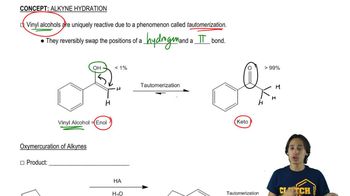
Alkyne Hydration

Nucleophilic Substitution

Nucleophilic substitution is a fundamental reaction mechanism in organic chemistry where a nucleophile replaces a leaving group in a molecule. In this question, isobutyl bromide serves as a substrate for nucleophilic attack, which is essential for forming the desired alcohols in the final product. Understanding the conditions that favor either SN1 or SN2 mechanisms will help in predicting the outcome of the reaction.
Recommended video:
Guided course
01:47
Nucleophiles and Electrophiles can react in Substitution Reactions.

Stereochemistry

Stereochemistry involves the study of the spatial arrangement of atoms in molecules and how this affects their chemical behavior. The target compound, meso-2,7-dimethyloctane-4,5-diol, has specific stereochemical requirements, including the presence of chiral centers and a plane of symmetry. Recognizing how to control stereochemistry during synthesis is vital for achieving the correct configuration in the final product.
Recommended video:
1:38
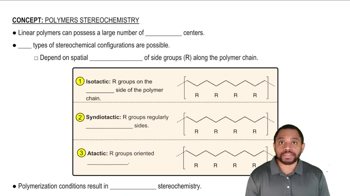
Polymer Stereochemistry Concept 1
Related Practice
Textbook Question

Using any necessary inorganic reagents, show how you would convert acetylene and isobutyl bromide to

(b) (±)-2,7-dimethyloctane-4,5-diol.

853
views

Textbook Question

The following functional-group interchange is a useful synthesis of aldehydes.

(c) Explain why a nucleophilic reagent such as ethoxide adds to an alkyne more easily than it adds to an alkene.

743
views
Textbook Question

Deduce the structure of each compound from the information given. All unknowns in this problem have molecular formula C8H12.

(a) Upon catalytic hydrogenation, unknown W gives cyclooctane. Ozonolysis of W, followed by reduction with dimethyl sulfide, gives octanedioic acid, HOOC–(CH2)6–COOH. Draw the structure of W.

819
views
Textbook Question

Show how you would convert the following starting materials into the target compound. You may use any additional reagents you need.

1084
views
Textbook Question

The following functional-group interchange is a useful synthesis of aldehydes.

(a) What reagents were used in this chapter for this transformation? Give an example to illustrate this method.

(b) This functional-group interchange can also be accomplished using the following sequence.

Propose mechanisms for these steps.

667
views
Textbook Question

Deduce the structure of each compound from the information given. All unknowns in this problem have molecular formula C8H12.

(c) Upon catalytic hydrogenation, unknown Y gives cyclooctane. Ozonolysis of Y, followed by reduction with dimethyl sulfide, gives a three-carbon dialdehyde and a five-carbon dialdehyde. Draw the structure of Y.

(d) Upon catalytic hydrogenation, unknown Z gives cis-bicyclo[4.2.0]octane. Ozonolysis of Z, followed by reduction with dimethyl sulfide, gives a cyclobutane with a three-carbon aldehyde (–CH2–CH2–CHO) group on C1 and a one-carbon aldehyde (–CHO) group on C2. Draw the structure of Z.

1205
views