Ch.1 - Structure and Bonding
Wade - Organic Chemistry 9th Edition
Wade9th EditionOrganic ChemistryISBN: 9780135213728Not the one you use?Change textbook
Chapter 1, Problem 31i-k

Draw a Lewis Structure for each species.
i. CH3OSO2OCH3
j. CH3C(NH)CH3
k. (CH3)3CNO

Verified step by step guidance
1
Identify the total number of valence electrons for each species. For example, in CH3OSO2OCH3, count the valence electrons from each atom: C (4), H (1), O (6), and S (6).
Arrange the atoms to reflect the molecular structure. Typically, the least electronegative atom is central, except for hydrogen, which is always terminal. For CH3OSO2OCH3, consider the connectivity: CH3-O-SO2-O-CH3.
Distribute the valence electrons around the atoms, starting with the outer atoms, to satisfy the octet rule (or duet for hydrogen). For example, in CH3OSO2OCH3, ensure each oxygen has 8 electrons around it.
Form double or triple bonds if necessary to satisfy the octet rule for each atom. For instance, in CH3OSO2OCH3, you may need to form a double bond between sulfur and one of the oxygens.
Check the formal charges on each atom to ensure the most stable structure. Adjust the bonding if needed to minimize formal charges, ensuring the overall charge of the molecule is correct.

Verified video answer for a similar problem:

This video solution was recommended by our tutors as helpful for the problem above.
Video duration:
3m
Was this helpful?

Key Concepts

Here are the essential concepts you must grasp in order to answer the question correctly.

Lewis Structures

Lewis structures are diagrams that represent the bonding between atoms of a molecule and the lone pairs of electrons that may exist. They help visualize the arrangement of electrons in molecules, showing how atoms are connected and the distribution of valence electrons. Understanding Lewis structures is crucial for predicting molecular geometry, reactivity, and properties.
Recommended video:
Guided course
04:12
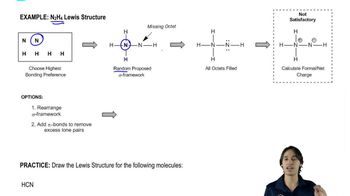
Drawing the Lewis Structure for N2H4.

Valence Electrons

Valence electrons are the outermost electrons of an atom and are involved in forming chemical bonds. The number of valence electrons determines an atom's bonding behavior and is essential for drawing Lewis structures. For example, carbon has four valence electrons, allowing it to form four covalent bonds, which is key in organic molecules.
Recommended video:
Guided course
03:40
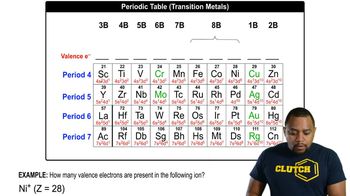
Valence Electrons of Transition Metals

Formal Charge

Formal charge is a concept used to determine the charge distribution within a molecule. It is calculated by comparing the number of valence electrons in an isolated atom to the number assigned in a Lewis structure. Minimizing formal charges in a Lewis structure leads to the most stable configuration, which is important for accurately representing molecules like CH3OSO2OCH3, CH3C(NH)CH3, and (CH3)3CNO.
Recommended video:
Guided course
01:34
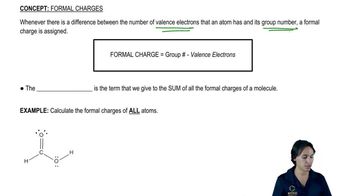
Calculating formal and net charge.