Which is a stronger base: ethoxide ion or acetate ion? Give pKb values (without looking them up) to support your choice.
Ch. 2 - Acids and Bases; Functional Groups
Chapter 2, Problem 21d,e
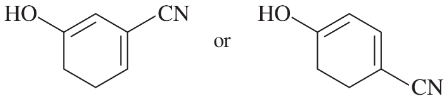
Choose the more acidic member of each pair of isomers, and show why the acid you chose is more acidic.
(d) 
(e) 
Verified step by step guidance1
Step 1: Analyze the first pair of isomers. Both structures contain a carbonyl group and an amine group. The difference lies in the position of the double bond relative to the amine group.
Step 2: Consider the resonance effects. In the first structure, the double bond is conjugated with the carbonyl group, which can stabilize the negative charge on the conjugate base through resonance. This stabilization increases acidity.
Step 3: In the second structure, the double bond is not conjugated with the carbonyl group, reducing the resonance stabilization of the conjugate base, making it less acidic compared to the first structure.
Step 4: Analyze the second pair of isomers. Both structures contain a phenol group and a cyano group. The difference lies in the position of the cyano group relative to the hydroxyl group.
Step 5: Consider the inductive and resonance effects. The cyano group is an electron-withdrawing group, which can increase acidity by stabilizing the negative charge on the conjugate base. The position of the cyano group relative to the hydroxyl group affects the extent of this stabilization. The ortho position (first structure) allows for stronger electron-withdrawing effects compared to the para position (second structure), making the ortho isomer more acidic.

Verified video answer for a similar problem:
This video solution was recommended by our tutors as helpful for the problem above.
Video duration:
13mWas this helpful?
Key Concepts
Here are the essential concepts you must grasp in order to answer the question correctly.
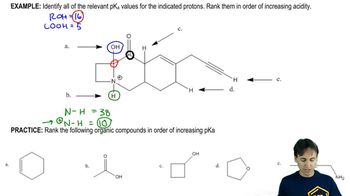
Acidity and pKa
Acidity in organic chemistry refers to the tendency of a compound to donate a proton (H+). The strength of an acid is often measured by its pKa value; lower pKa values indicate stronger acids. Understanding the relationship between structure and acidity is crucial, as factors like electronegativity and resonance can significantly influence a compound's ability to stabilize the negative charge of its conjugate base.
Recommended video:
Guided course
Identifying pKa values
Resonance Stabilization
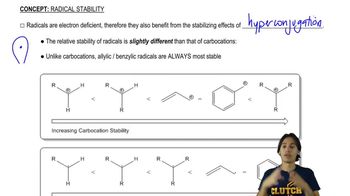
Resonance stabilization occurs when a molecule can be represented by multiple valid Lewis structures, allowing for the delocalization of electrons. This delocalization can stabilize the conjugate base formed after deprotonation, making the original acid stronger. Identifying resonance structures helps predict which isomer will be more acidic based on the stability of its conjugate base.
Recommended video:
Guided course
The radical stability trend.
Inductive Effect
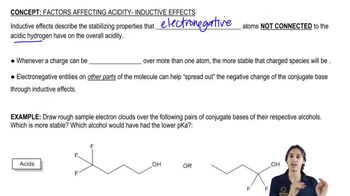
The inductive effect refers to the electron-withdrawing or electron-donating effects of substituents on a molecule, which can influence acidity. Electronegative atoms or groups near the acidic proton can stabilize the negative charge on the conjugate base through inductive withdrawal of electron density. Recognizing how different substituents affect the acidity of isomers is essential for determining which isomer is more acidic.
Recommended video:
Guided course
Understanding the Inductive Effect.
Related Practice
Textbook Question
724
views
Textbook Question
Acetic acid can also react as a very weak base (pKb = 20). Two different sites on acetic acid might become protonated to give the conjugate acid. Draw both of these possible conjugate acids, and explain (resonance) why the correct one is more stable. Calculate the pKa of this conjugate acid.
1027
views
Textbook Question
Choose the more basic member of each pair of isomers, and show why the base you chose is more basic.
c.
d.
791
views
Textbook Question
Choose the more basic member of each pair of isomers, and show why the base you chose is more basic.
(a)
(b)
1168
views
Textbook Question
Choose the more acidic member of each pair of isomers, and show why the acid you chose is more acidic.
(f)
(g)
601
views
Textbook Question
Choose the more acidic member of each pair of isomers, and show why the acid you chose is more acidic.
(a)
(b)
(c)
2040
views